Alfvén waves and their damping
Advanced level
This page uses the equations derived in Resistive MHD: deriving the equations, in particular the energy budget of Step 7. The result is the exact solution the Simulation Lab code is tested against.
A magnetic field line behaves like a string under tension. Pluck it, and the kink travels along the field. This is the Alfvén wave. The tension of a field \(B_0\) is \(B_0^2/\mu_0\) and the mass loading is \(\rho_0\), so, as for a string with speed \(\sqrt{\text{tension}/\text{mass density}}\), the wave moves at the Alfvén speed
Question: in resistive MHD, how fast does an Alfvén wave lose its energy, and where does the energy go?
1. Linearizing the resistive MHD equations
The equilibrium. Start from a uniform plasma at rest: density \(\rho_0\), pressure \(p_0\), velocity \(\mathbf{v}_0 = 0\), and a uniform field \(\mathbf{B}_0 = B_0\hat{\mathbf{x}}\). Because everything is uniform, \(\nabla p_0 = 0\) and \(\mu_0\mathbf{J}_0 = \nabla\times\mathbf{B}_0 = 0\): no force acts, so this state stays as it is.
The perturbation. Now disturb it slightly. Every quantity is its equilibrium value plus a small change, marked with a subscript 1:
with \(\mu_0\mathbf{J}_1 = \nabla\times\mathbf{B}_1\). "Small" means
Linearizing means substituting these into the equations and keeping only terms of first order in \(\epsilon\). Terms with no subscript-1 quantity are the equilibrium, which already balances; terms with two subscript-1 quantities (such as \(\rho_1\mathbf{v}_1\)) are of order \(\epsilon^2\) and are dropped.
We wish to linearize the following equations, the complete set without gravity and heat conduction:
Each one turns into its linear form as follows.
Continuity. Substitute:
\(\rho_0\) is constant, so \(\partial_t\rho_0 = 0\) and \(\nabla\cdot(\rho_0\mathbf{v}_1) = \rho_0\nabla\cdot\mathbf{v}_1\). \(\rho_1\mathbf{v}_1\) is second order. This leaves
Momentum. Substitute:
Drop \(\rho_1\,\partial_t\mathbf{v}_1\), \(\mathbf{v}_1\cdot\nabla\mathbf{v}_1\), \(\mathbf{J}_1\times\mathbf{B}_1\) and \(\rho_1\nu[\ldots]\) (all second order), and use \(\nabla p_0 = 0\):
Induction. Substitute:
\(\mathbf{B}_0\) is constant and uniform, so \(\partial_t\mathbf{B}_0 = 0\) and \(\nabla^2\mathbf{B}_0 = 0\). \(\mathbf{v}_1\times\mathbf{B}_1\) is second order. This leaves
Pressure. Substitute:
\(\partial_tp_0 = 0\) and \(\nabla p_0 = 0\). \(\mathbf{v}_1\cdot\nabla p_1\) and \(p_1\nabla\cdot\mathbf{v}_1\) are second order. The heating terms are second order too: \(J_1^2\) is a product of two small quantities, and \(\Phi_\nu\) is quadratic in the velocity gradients. This leaves
So, to first order, the heating drops out of the pressure equation. It does not vanish: it is second order, and section 5 follows it through the energy budget.
2. The linearized equations for an Alfvén wave
Choose a disturbance that is sideways to the field and depends only on \(x\) (along \(\mathbf{B}_0\)) and \(t\):
\(\nabla\cdot\mathbf{B}_1 = \partial b/\partial z = 0\), as it must. Now put this into each linear equation.
Continuity and pressure. \(\nabla\cdot\mathbf{v}_1 = \partial v/\partial z = 0\): the flow does not compress the plasma. The two linear equations become \(\partial_t\rho_1 = 0\) and \(\partial_tp_1 = 0\), so if \(\rho_1\) and \(p_1\) start at zero, they stay zero: \(\rho = \rho_0\) and \(p = p_0\).
Momentum. The current is
so the Lorentz force is
This is the magnetic tension \((\mathbf{B}_0\cdot\nabla)\mathbf{B}_1/\mu_0\). There is no magnetic-pressure part: that would be \(-\nabla(\mathbf{B}_0\cdot\mathbf{B}_1)/\mu_0\), and \(\mathbf{B}_0\cdot\mathbf{B}_1 = 0\) because the disturbance is perpendicular to \(\mathbf{B}_0\). With \(p_1 = 0\) and \(\nabla\cdot\mathbf{v}_1 = 0\), the viscous term is \(\rho_0\nu\,\partial_x^2v\,\hat{\mathbf{z}}\). The \(z\)-component of the momentum equation is
Induction. \(\mathbf{v}_1\times\mathbf{B}_0 = vB_0\,(\hat{\mathbf{z}}\times\hat{\mathbf{x}}) = vB_0\,\hat{\mathbf{y}}\), and
With \(\eta\nabla^2\mathbf{B}_1 = \eta\,\partial_x^2b\,\hat{\mathbf{z}}\), the \(z\)-component of the induction equation is
Equations (1) and (2) are the whole problem. The first term on each right-hand side couples \(v\) and \(b\) (the wave); the second term diffuses each of them (the damping).
3. The ideal wave (η = ν = 0)
Differentiate (1) in time and use (2):
This is the wave equation, with speed \(v_A\). A wave travelling in \(+x\), \(v = f(x - v_At)\), gives from (2) \(b = -(B_0/v_A)\,f\), i.e.
So \(b^2/2\mu_0 = \rho_0v^2/2\) at every point: the wave carries equal kinetic and magnetic energy.
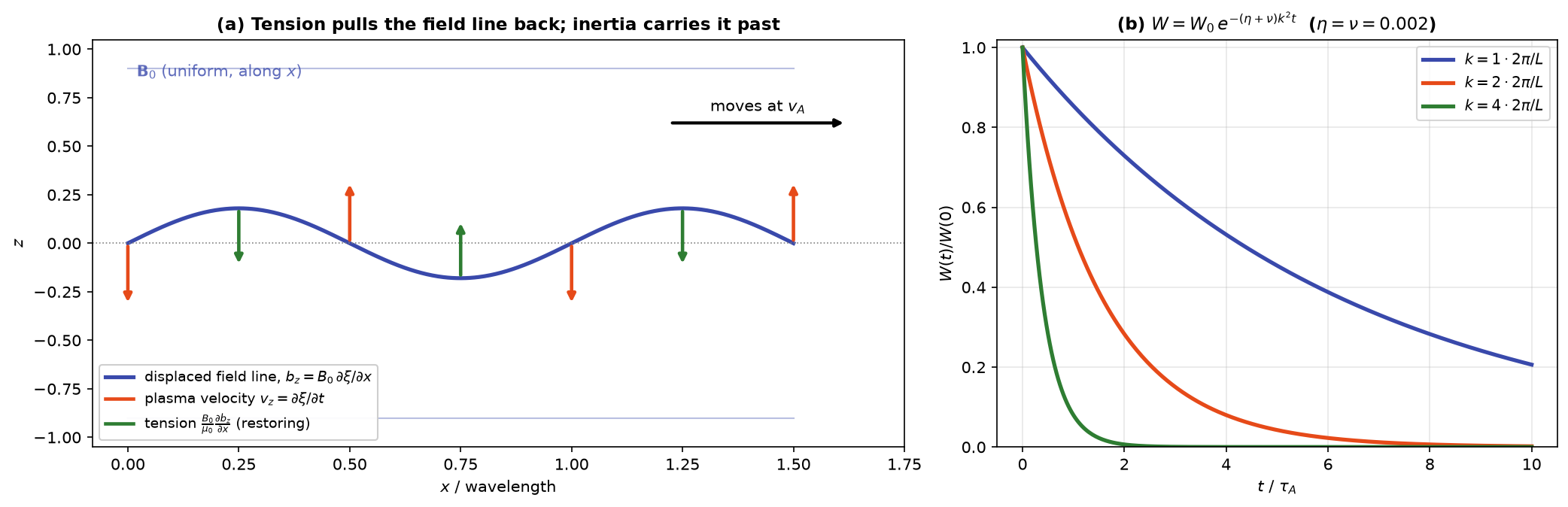
Writing the field-line displacement as \(\xi(x,t)\), \(v = \partial\xi/\partial t\) and \(b = B_0\,\partial\xi/\partial x\). The tension force per volume is then \(B_0^2\,\partial^2\xi/\partial x^2/\mu_0\): it pulls each bent piece of the line back toward the axis, and the plasma's inertia carries it past, just as for a string.
4. The energy of the wave
The energy density of the disturbance is the kinetic energy plus the magnetic energy:
\(B_0^2/2\mu_0\) is the constant background, and there is no cross term because \(b\perp\mathbf{B}_0\). So the wave energy in a volume \(V\) is
5. The energy equation in resistive MHD
Multiply (1) by \(v\) and (2) by \(b/\mu_0\), and add:
Each term on the right is rewritten with the product rule:
- \(v\,\partial_x b + b\,\partial_x v = \partial_x(vb)\): a pure flux.
- \(v\,\partial_x^2v = \partial_x(v\,\partial_xv) - (\partial_xv)^2\), and the same for \(b\).
So
with the energy flux
The two sinks are exactly the heating terms of Step 7:
- \(\dfrac{\eta}{\mu_0}(\partial_xb)^2 = \mu_0\eta J^2\), because \(J = -\partial_xb/\mu_0\): ohmic heating.
- \(\rho_0\nu(\partial_xv)^2 = \Phi_\nu\): viscous heating (Problem 4 shows this from the general \(\Phi_\nu\)).
The first part of the flux, \(-B_0vb/\mu_0\), is the Poynting flux. For the travelling wave, \(b = -\sqrt{\mu_0\rho_0}\,v\), it equals \(\rho_0v^2\,v_A\): the wave energy density \(\rho_0v^2\) carried forward at \(v_A\).
In a periodic box (or for a wave far from any boundary), the flux integrates to zero, leaving
The wave loses energy only to heat, at the rate set by its gradients.
6. A sinusoidal wave: W ∝ exp[−(η+ν)k²t]
Take a single wavelength-\(\lambda\) wave, \(k = 2\pi/\lambda\). For a sinusoid, the gradient squared averages to \(k^2\) times the value squared over a wavelength (\(\sin^2\) and \(\cos^2\) both average to \(\tfrac12\)):
So
With equal kinetic and magnetic energy, \(K = M = W/2\):
Does equipartition survive the damping? Look for solutions \(v, b \propto e^{ikx + st}\). Equations (1) and (2) become
Multiplying them gives the dispersion relation
whose roots are
- The wave still oscillates (at \(\Omega \approx kv_A\)), and its amplitude decays at \((\eta+\nu)k^2/2\). Energy is amplitude squared, so it decays at twice that, \((\eta+\nu)k^2\): the same result.
- With \(s + \nu k^2 = \tfrac12(\nu-\eta)k^2 + i\Omega\), one finds \(|s + \nu k^2|^2 = k^2v_A^2\), so the first equation gives \(|b| = \sqrt{\mu_0\rho_0}\,|v|\). Each damped mode keeps \(K = M\) exactly, even when \(\eta \ne \nu\).
Only the sum \(\eta + \nu\) matters. Resistivity damps the magnetic half of the energy, viscosity the kinetic half, and the wave keeps passing energy between the two halves, so each dissipates at the average rate.
Answer
A small-amplitude Alfvén wave of wavenumber \(k\) loses energy as \(W = W_0\,e^{-(\eta+\nu)k^2t}\). The energy goes into heat: ohmic heating \(\mu_0\eta J^2\) from the wave's current, and viscous heating \(\Phi_\nu\) from its sheared flow. Shorter waves (larger \(k\)) have steeper gradients and damp faster, as \(k^2\).
7. The code test
In the code's units (\(\rho_0 = B_0 = \mu_0 = 1\), so \(v_A = 1\);
Step 8b), the
cartesian_2d_alfven setup starts the travelling wave
i.e. \(b = -v\), the \(+x\) wave of section 3, in a periodic box of length 1 (\(k = 2\pi\)), with \(\eta = \nu = 0.002\). With \(\eta = \nu\), the dispersion relation gives \(\Omega = kv_A\) exactly and \(b = -v\) is exactly one damped mode, so the theory predicts
The simulation follows this to 0.3%:
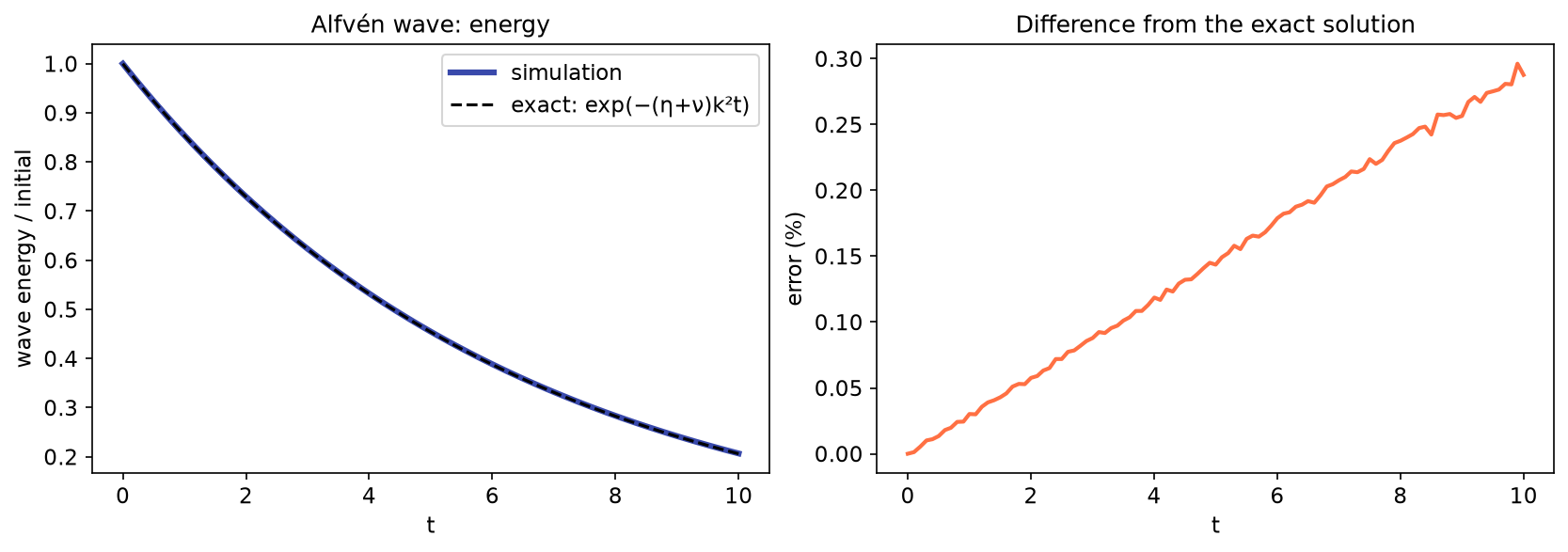
The test checks the tension force, the induction equation, and both dissipation terms at once. If any of them had a wrong sign or factor, the curve would bend away from the dashed line.
Practice problems
Try each problem before opening its solution. Click an option to check a concept question;
type a number and press Check for a numerical one (forms like 6.2e7 or 6.2x10^7 both work).
Concept questions
Problem 1
A wave with twice the wavenumber is launched in the same plasma. How does its energy damping rate compare?
- The same
- Twice as fast
- Four times as fast
- Half as fast
The rate is \((\eta+\nu)k^2\). Doubling \(k\) doubles every gradient, and the dissipation goes as gradient squared.
Problem 2
Where does the energy lost by the wave end up?
- It is radiated away as light
- It heats the plasma, raising the pressure
- It accelerates a large-scale flow along \(\mathbf{B}_0\)
- It strengthens the background field \(B_0\)
The sinks are \(\mu_0\eta J^2\) and \(\Phi_\nu\), which appear with a plus sign in the pressure equation. The pressure rise is second order in the amplitude, which is why the linear analysis can ignore it.
Problem 3
A plasma has \(\eta = 0.004\) and \(\nu = 0\). Compared with \(\eta = \nu = 0.002\), its Alfvén waves damp
- at the same rate
- twice as fast
- half as fast
- not at all, because there is no viscosity
Only \(\eta + \nu\) enters. The wave shares its energy equally between flow and field, so it does not matter which half is damped.
Show that…
Problem 4: viscous heating of the wave
Starting from \(\Phi_\nu = 2\rho\nu\left[S_{ij}S_{ij} - \tfrac13(\nabla\cdot\mathbf{v})^2\right]\), with \(S_{ij} = \tfrac12(\partial_iv_j + \partial_jv_i)\), show that for \(\mathbf{v} = v(x,t)\,\hat{\mathbf{z}}\), \(\Phi_\nu = \rho\nu(\partial_xv)^2\).
Hint
Only one derivative of \(\mathbf{v}\) is non-zero. Which components of \(S_{ij}\) does it appear in?
Proof
The only non-zero derivative is \(\partial_xv_z\), so \(\nabla\cdot\mathbf{v} = 0\) and the only non-zero strain components are \(S_{xz} = S_{zx} = \tfrac12\partial_xv\). Then \(S_{ij}S_{ij} = 2\cdot\tfrac14(\partial_xv)^2 = \tfrac12(\partial_xv)^2\), and \(\Phi_\nu = 2\rho\nu\cdot\tfrac12(\partial_xv)^2 = \rho\nu(\partial_xv)^2\).
Problem 5: the Poynting flux of the wave
Show that for the travelling wave \(b = -\sqrt{\mu_0\rho_0}\,v\), the Poynting flux \(-B_0vb/\mu_0\) equals the wave energy density times \(v_A\).
Proof
\(-B_0vb/\mu_0 = B_0\sqrt{\mu_0\rho_0}\,v^2/\mu_0 = \rho_0v^2\,B_0/\sqrt{\mu_0\rho_0} = \rho_0v^2\,v_A\). With equipartition the energy density is \(\rho_0v^2/2 + b^2/2\mu_0 = \rho_0v^2\). So the flux is the energy density moving at \(v_A\).
Numbers
Problem 6
In the code test (\(k = 2\pi\), \(\eta = \nu = 0.002\), code units), after how many Alfvén times has the wave energy fallen by a factor \(e\)?
Solution
\(t = 1/[(\eta+\nu)k^2] = 1/(0.004\times39.48) \approx 6.33\,\tau_A\).