What is magnetic reconnection?
Magnetic reconnection is a change in the connectivity of magnetic field lines that happens in a thin region where the frozen-in condition breaks down. It converts magnetic energy into plasma heating, bulk flows and energetic particles.
The picture
Bring together two regions of oppositely directed magnetic field. Between them the field must reverse, so by Ampère's law a current sheet forms. As the plasma pushes the field lines together, the sheet thins until diffusion (or kinetic effects) matter. Field lines then break and reconnect at an X-point:
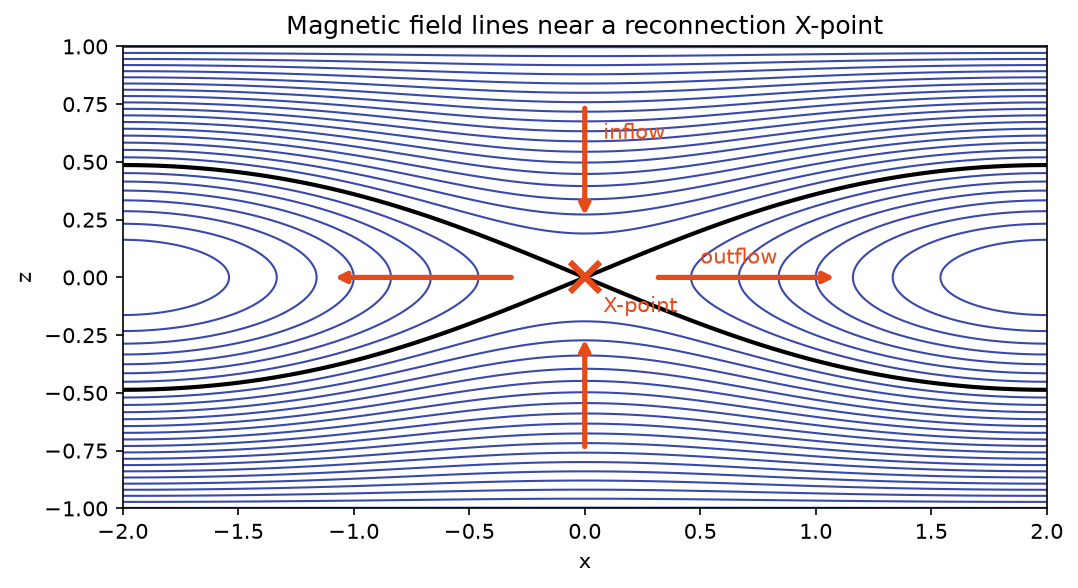
- Inflow: plasma and field are carried towards the sheet from above and below.
- Diffusion region: a small region around the X-point where the plasma decouples from the field.
- Outflow: newly reconnected, sharply bent field lines straighten out like slingshots, ejecting plasma sideways at roughly the Alfvén speed.
Where it happens
| Setting | What reconnection does |
|---|---|
| Solar flares and CMEs | Releases \(10^{25}\) J of magnetic energy in minutes |
| Earth's dayside magnetopause | Lets solar wind energy into the magnetosphere |
| Earth's magnetotail | Drives substorms and the aurora |
| Tokamaks | Sawtooth crashes and disruptions |
The key questions
- How fast? What sets the rate at which flux is reconnected?
- Where does the energy go? Into heat, flows or energetic particles, and in what proportion?
- What breaks the frozen-in condition? Resistivity, or kinetic effects?
The next pages build the simplest models that address the first question.
Practice problems
Try each problem before opening its solution. Click an option to check a concept question;
type a number and press Check for a numerical one (forms like 6.2e7 or 6.2x10^7 both work).
Concept questions
Problem 1
What does magnetic reconnection change?
- The connectivity of magnetic field lines
- The total magnetic flux through the whole system
- The direction of the electric current everywhere
- The charge of the particles
Reconnection cuts and rejoins field lines, changing which plasma elements are connected by the same line. Flux is redistributed, not created or destroyed.
Problem 2
Roughly how fast is plasma ejected from a reconnection site?
- About the sound speed
- About the Alfvén speed
- About the speed of light
- About the inflow speed
The magnetic tension of the newly reconnected, kinked field lines flings plasma out at about the Alfvén speed.
Problem 3
Where does the frozen-in condition break down?
- Everywhere in the inflow region
- Only in a small diffusion region around the X-point
- Only in the outflow jets
- Nowhere: reconnection is ideal
Outside a thin diffusion region the plasma stays frozen in. Inside it, resistivity or kinetic effects let field lines slip and reconnect.
Show that…
Problem 4: ideal MHD cannot reconnect
Explain, using the frozen-in theorem, why ideal MHD can never change the connectivity of field lines.
Hint
What does the frozen-in theorem say about two fluid elements that start on the same field line?
Proof
In ideal MHD, two fluid elements on the same field line stay on the same field line for all time. Connectivity (which elements are linked by a line) is therefore preserved, so it can only change where the ideal condition \(\mathbf{E}+\mathbf{v}\times\mathbf{B}=0\) fails.
Problem 5: the outflow speed
Show that if all the magnetic energy density \(B^2/2\mu_0\) of the inflow is converted into kinetic energy \(\rho v^2/2\), the outflow speed is \(v_A\).
Hint
Set the two energy densities equal and solve for \(v\).
Proof
\(\rho v^2/2 = B^2/2\mu_0\Rightarrow v = B/\sqrt{\mu_0\rho} = v_A\).
Numbers
Problem 6
What is the magnetic energy density of a coronal field of \(B = 0.01\) T, in J/m³?
Solution
\(B^2/2\mu_0 = 10^{-4}/(2\times1.257\times10^{-6}) = 39.8\) J/m³.
Problem 7
How much magnetic energy is stored in a coronal volume \((10^7\ \text{m})^3\) with that field? An order of magnitude is enough.
Solution
\(39.8\times10^{21}\approx 4\times10^{22}\) J: comparable to a large solar flare.
Problem 8
Estimate the outflow speed in the magnetotail, where \(B = 20\) nT and the proton density is 0.3 cm\(^{-3}\). Give it in km/s.
Solution
\(v_A = B/\sqrt{\mu_0nm_p} = 2\times10^{-8}/\sqrt{1.257\times10^{-6}\times3\times10^5\times1.67\times10^{-27}}\approx 800\) km/s.