Bending flux tubes
Advanced level
This page assumes vector calculus and ideal MHD. Read the Plasma Basics section first, especially MHD and frozen-in flux.
The question this page answers: take a straight bundle of magnetic field lines in a plasma and bend it. What happens to the magnetic field, especially where the bend is sharpest, and why does that matter for space plasmas and reconnection?
The short answer
- A restoring force appears. Bent field lines pull back towards straight, like a plucked guitar string. This magnetic tension points towards the centre of the bend.
- The field becomes stronger on the inside of the bend than on the outside.
- The field strength along the tube barely changes unless the bend also stretches the tube. If it does, \(B/\rho\) grows in proportion to the stretching. With the ends held fixed, that increase is concentrated near the ends, not at the most bent point.
The rest of the page explains where each of these comes from.
Why field lines bend in a plasma
In a highly conducting plasma, magnetic field lines are frozen in: plasma and field move together across the field (see MHD and frozen-in flux). So whenever different parts of the plasma move differently, they drag their field lines with them, and the field lines bend. Bending is not exotic. It happens wherever plasma flows are uneven:
| Where | What bends the field |
|---|---|
| Coronal loops on the Sun | Convection in the photosphere moves the loop's footpoints around |
| Solar wind around Earth | The flow drapes the interplanetary field around the magnetosphere |
| Earth's magnetotail | The solar wind drags field lines far downstream and stretches them |
| Reconnection outflows | Newly reconnected field lines are sharply kinked at birth |
| Alfvén waves | A wave is a travelling bend in the field lines |
Why it matters. Bending a field line takes work, and that work is stored as magnetic energy. The bent field then pushes back. This is how flows in a plasma load energy into the magnetic field, and how the field later gives it back: as waves, as fast jets (reconnection outflows), or as heat. Solar flares, substorms and coronal heating all start with field lines that have been bent, twisted or stretched.
Four ways a field line ends up bent
Question: if nothing holds the ends of a tube, won't a push just slide it sideways? And what about a closed flux rope, which has no ends at all?
The key idea: a field line bends only if different parts of it are displaced by different amounts. If every point of a tube moves sideways by the same amount, the tube simply slides: no curvature, no tension. So the real question is what makes the displacement vary along the tube? There are four common answers:
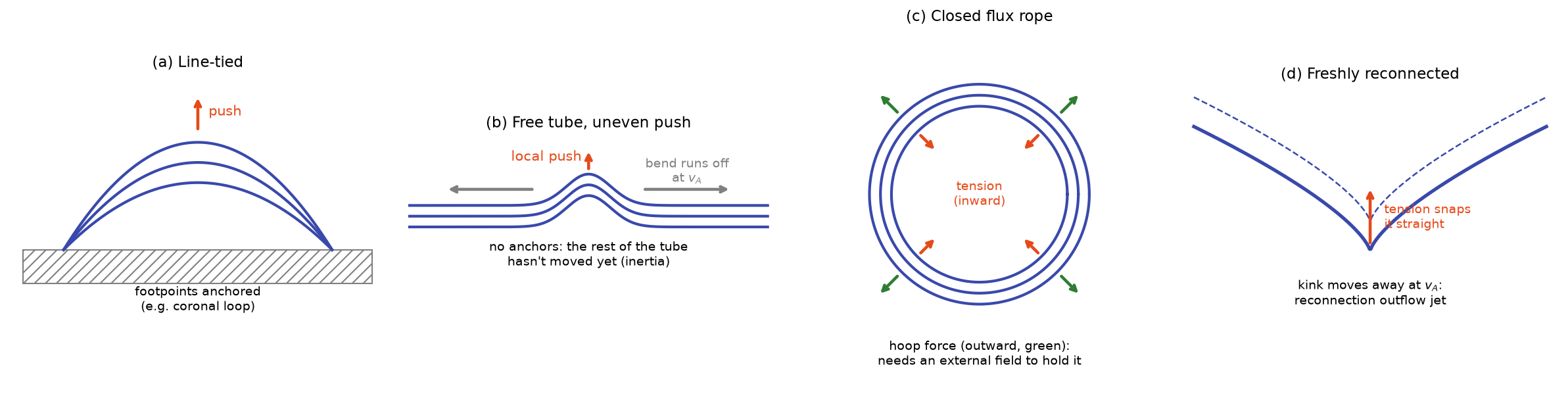
| Scenario | What makes the displacement vary along the tube | Example | Does the bend stretch the line? |
|---|---|---|---|
| (a) Line-tied | The ends are anchored and cannot move; only the middle is pushed | Coronal loops, lab devices | Yes, always (the ends are fixed) |
| (b) Free tube, uneven push | The push itself varies along the tube, and the far parts of the tube have not moved yet. Information travels along the field only at \(v_A\), so for a time \(\lesssim d/v_A\) the plasma a distance \(d\) away acts like an anchor through its inertia | Alfvén waves, solar wind draping around a planet | Yes, by the same \(\tfrac12\int\xi'^2\) as (a), between points that have not moved |
| (c) Closed or intrinsically curved | Nothing needs to push: the field lines are curved by the shape of the current that makes them | Ring-shaped flux ropes, Earth's dipole field lines | Only if the whole structure grows or shrinks (a ring's length is \(2\pi R\)) |
| (d) Freshly reconnected | Reconnection joins two field lines into one with a sharp kink | Reconnection outflows | The kink straightens, so the line shortens and releases energy |
Answer
No anchoring is needed to bend a tube; what is needed is a displacement that varies along it. Anchored ends (a) are the simplest way to get that, which is why sections 4–6 use them, but an uneven push on a long free tube (b) bends it just as well, because the distant plasma's inertia holds it in place until a signal arrives at \(v_A\). A closed flux rope (c) is curved without any push at all. Sections 1–3 (tension, the stronger field on the inside, and the different shapes) apply to all four scenarios.
What happens to a closed, ring-shaped flux rope?
A ring of radius \(R\) made of field lines running around it (and usually twisted, so a current also flows around the ring) feels three things:
- Tension of the field running around the ring pulls it inward, with force density \(\sim B^2/(\mu_0R)\), exactly as in section 1.
- Magnetic pressure is stronger on the inner side of the ring (section 2), which pushes outward.
- The current flowing around the ring and the field it produces give the hoop force, also outward: like any current loop, it tries to expand.
For a current-carrying rope the outward forces win, so the ring would expand on its own. In the solar corona it is held down by an external "strapping" field from the surrounding active region. If that field weakens too quickly with height, the ring cannot be held and erupts: the torus instability (Kliem & Török 2006), a leading explanation for coronal mass ejections. If the ring does expand, its field lines lengthen in proportion to \(R\), so \(B/\rho\propto R\) by the same argument as section 4.
Key terms
| Term | Meaning |
|---|---|
| Flux tube | A bundle of field lines through a small area \(A\). The flux \(\Phi = BA\) is the same through every cross-section, because \(\nabla\cdot\mathbf{B}=0\). |
| Unit vector \(\hat{\mathbf{b}}\) | \(\mathbf{B}/B\), the local direction of the field. |
| Curvature vector \(\boldsymbol{\kappa}\) | How fast \(\hat{\mathbf{b}}\) turns as you move along the field: \(\boldsymbol{\kappa} = (\hat{\mathbf{b}}\cdot\nabla)\hat{\mathbf{b}}\). It points towards the centre of the bend. |
| Radius of curvature \(R_c\) | The radius of the circle that best fits the bend, \(R_c = 1/\lvert\boldsymbol{\kappa}\rvert\). Small \(R_c\) = sharp bend. |
| Footpoints | The two ends of a field line, where it is anchored. |
| Line-tying | Holding the footpoints fixed (explained in section 5). |
| Sagitta \(h\) | How far the middle of the bent line sits from the straight line joining its ends. |
| Plasma β | Plasma pressure divided by magnetic pressure, \(\beta = 2\mu_0 p/B^2\). |
| Alfvén speed \(v_A\) | \(B/\sqrt{\mu_0\rho}\), the speed at which bends travel along the field. |
1. A bent field line pulls back: magnetic tension
Question: what force does a bent field exert on the plasma?
The magnetic force per unit volume is \(\mathbf{J}\times\mathbf{B}\). Using Ampère's law \(\mu_0\mathbf{J} = \nabla\times\mathbf{B}\) and a vector identity, it splits into two parts:
Here \(\nabla_\perp\) means the gradient taken only across the field (the part along \(\mathbf{B}\) cancels out).
- Magnetic pressure pushes plasma from where the field is strong to where it is weak, like a gas pressure of \(B^2/2\mu_0\).
- Magnetic tension exists only where field lines are curved. It points along \(\boldsymbol{\kappa}\), towards the centre of the bend, with size \(B^2/(\mu_0 R_c)\).
Answer
A bent field line feels a tension force \(B^2/(\mu_0R_c)\) towards the centre of curvature. It tries to straighten the line. The sharper the bend (smaller \(R_c\)), the stronger the pull. In a straight tube \(\boldsymbol{\kappa}=0\) and there is no tension at all.
What it implies: Alfvén waves. Field lines behave like strings with tension \(B^2/\mu_0\) (per unit area), loaded with plasma of density \(\rho\). A wave on a string travels at \(\sqrt{\text{tension}/\text{mass density}}\), so a bend travels along the field at
the Alfvén speed. Release a bent field line and the bend runs off as a shear Alfvén wave. The same tension is the "slingshot" that drives reconnection outflows at about \(v_A\).
2. The field is stronger on the inside of the bend
Question: across the tube, is the field the same on the inner and outer side of the bend?
Take the simplest case, where no current flows inside the tube, \(\nabla\times\mathbf{B}=0\) (a good approximation for coronal loops, where the plasma pressure is small). By Stokes' theorem, the line integral of \(\mathbf{B}\) around any closed loop is then zero:
The trick is to choose a loop that makes this tell us something. In the figure below, the loop (black, in the plane of the bend) is made of four pieces, all spanning the same angle \(\theta\) as seen from the centre of curvature:
Drag to rotate · scroll to zoom · double-click to reset
Drag to rotate the tube and look at it from the side; hover over ①–④ to see each segment's contribution; move the slider to make the tube thicker or thinner. The colour on the tube is the field strength.
| Segment | Path | Direction relative to \(\mathbf{B}\) | Length | Contribution to \(\oint\mathbf{B}\cdot d\mathbf{l}\) |
|---|---|---|---|---|
| ① | Along the inner field line (red), radius \(R_c - a\) | Along \(\mathbf{B}\) | \((R_c - a)\,\theta\) | \(+B_{\text{in}}\,(R_c - a)\,\theta\) |
| ② | Straight across the tube, outwards | Perpendicular to \(\mathbf{B}\) | \(2a\) | \(0\) |
| ③ | Back along the outer field line (blue), radius \(R_c + a\) | Against \(\mathbf{B}\) | \((R_c + a)\,\theta\) | \(-B_{\text{out}}\,(R_c + a)\,\theta\) |
| ④ | Straight across the tube, inwards | Perpendicular to \(\mathbf{B}\) | \(2a\) | \(0\) |
The two connectors ② and ④ cross the field at right angles, so \(\mathbf{B}\cdot d\mathbf{l} = 0\) on them. Only the two arcs are left, and their sum must vanish:
Why, in words: both arcs span the same angle, but the inner arc is shorter. For the two contributions to cancel, the field on the shorter path must be stronger. This is the same reason the field around a straight wire falls off as \(B\propto 1/r\): there, too, field lines are circles, and the shorter circles carry the stronger field.
Answer
Yes, the field is stronger on the inner side of the bend, by a fraction of about \(2a/R_c\). Field lines on the inside are packed closer together. For a tube whose radius is 10% of its radius of curvature, the inside field is about 20% stronger than the outside.
Why the forces work out. Because \(B\) is stronger on the inside, magnetic pressure pushes outward, opposing the inward tension. In a current-free field the two cancel exactly, \(B^2\boldsymbol{\kappa} = \nabla_\perp(B^2/2)\), so a current-free bent tube feels no net force and can stay bent. If a current flows, they no longer cancel, and the leftover force either straightens the tube or is balanced by plasma pressure.
If a current does flow: the general identity
Writing \(\mathbf{B} = B\hat{\mathbf{b}}\),
The last term shows that curvature on its own implies a current along \(\hat{\mathbf{b}}\times\boldsymbol{\kappa}\), the binormal direction (perpendicular both to the field and to the direction of the bend). If the plasma cannot set up the inside/outside field difference that cancels it, a real current flows across the bend instead.
3. Different ways to deform a flux tube
Question: a straight tube can be deformed in many ways. Which ones are physically different?
Where the mode number m comes from
A straight, round tube looks the same from every angle \(\varphi\) around its axis. Because of that symmetry, any small deformation of the tube can be broken into simple pieces, each of which varies around the tube as \(\cos(m\varphi)\), just as a musical sound can be broken into pure tones (a Fourier series). For small deformations each piece evolves on its own, so stability theory studies one \(m\) at a time. Written out, the sideways displacement \(\boldsymbol{\xi}\) of the tube's surface is
where \(z\) runs along the tube. Two numbers label each piece:
- \(m\), the azimuthal mode number, counts how many bulges the cross-section has going once around the tube. It must be a whole number, because going all the way round (\(\varphi\to\varphi+2\pi\)) has to bring you back to the same point.
- \(k_\parallel\), the parallel wavenumber, says how quickly the deformation changes along the field (wavelength \(2\pi/k_\parallel\)). Bending field lines costs energy \(\propto k_\parallel^2\), so deformations that vary slowly along \(\mathbf{B}\) are cheap and those that vary quickly are expensive.
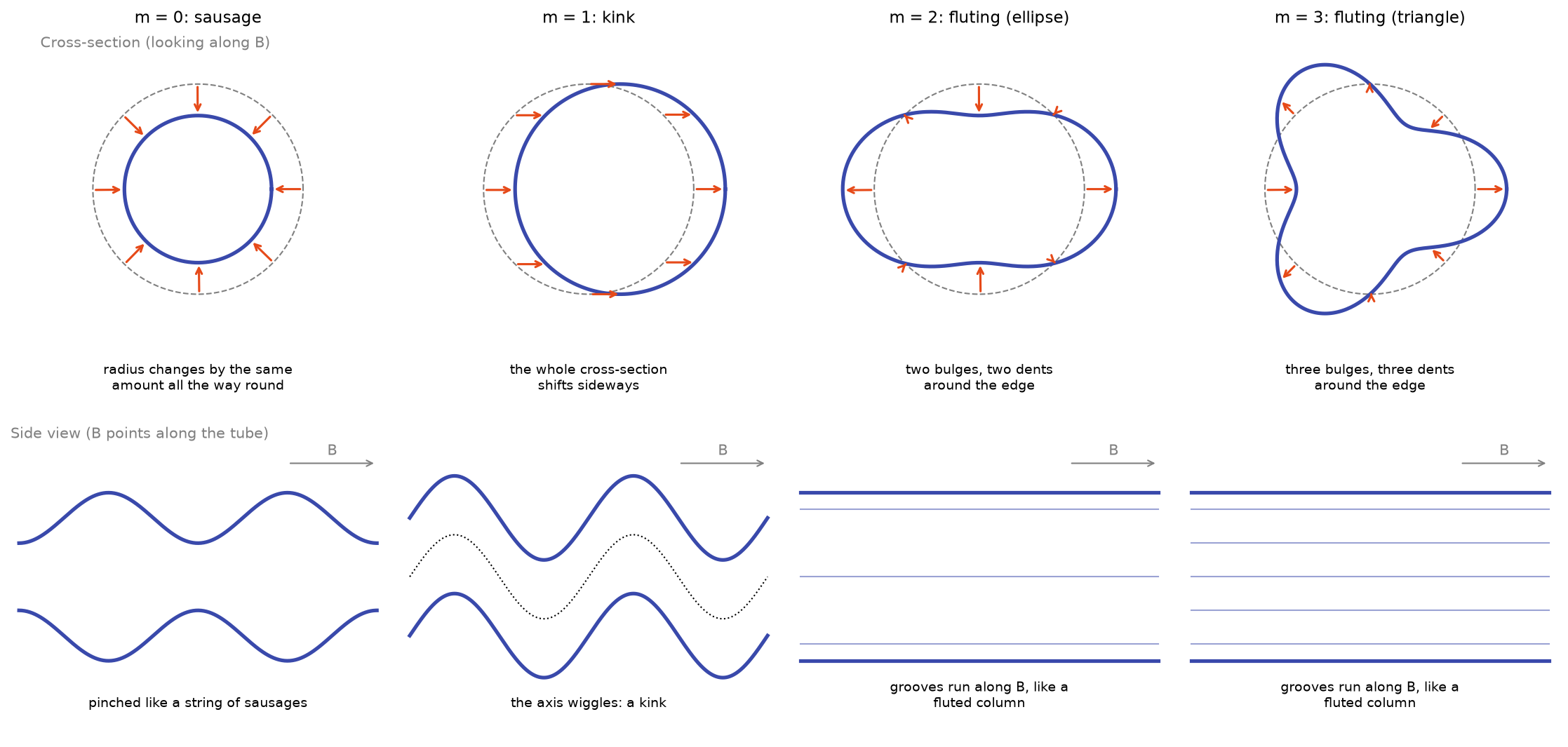
| \(m\) | Cross-section | Side view | Name, and where it comes from |
|---|---|---|---|
| 0 | Stays round, radius changes | Necks and bulges | Sausage: looks like a string of sausages |
| 1 | Stays round, shifts sideways | The axis wiggles | Kink: the tube kinks like a garden hose |
| 2, 3, … | Gains 2, 3, … bulges | Grooves running along \(\mathbf{B}\) | Flute: like the grooves of a fluted column |
The names and the \(m\) labels come from 1950s fusion research, where Kruskal, Shafranov and others asked which of these shapes would grow and destroy a confined plasma column.
The shapes in 3D
Picture five field lines threading a disk: one on the axis, four around it at radius \(a\). Keep the two ends fixed and move the lines in between.
Use the buttons under the plot to switch between deformations, and drag to rotate.
Drag to rotate · scroll to zoom · double-click to reset
| Deformation | What happens to the lines | Current that appears | Where it matters |
|---|---|---|---|
| Planar bend (\(m=1\)) | Whole bundle shifts sideways; the axis curves in one plane | Across the bend (binormal) | Alfvén waves, draped field |
| Helical kink (\(m=1\)) | The axis corkscrews | Same, with helical structure | Kink instability of twisted loops |
| Twist | Outer lines wind around the central one | Along the axis, \(J_z\) | Twisted coronal loops, flux ropes |
| Shear | Neighbouring lines are displaced by different amounts | A thin sheet inside the tube | Sheared arcades before flares |
| Sausage (\(m=0\)) | The tube is pinched at some heights, swollen at others; \(B\propto 1/A\) rises at the pinches | Around the tube | Compressive waves in loops |
| Fluting (\(m\ge2\)) | The cross-section distorts; lines bulge in some places, dip in others | Weak if \(k_\parallel\approx0\) | Interchange instability |
Two more terms you will meet:
- Twist and writhe. Twist is how much the lines wind around the tube's axis. Writhe is how much the axis itself coils in space. Călugăreanu's theorem says their sum, the linking number, is fixed for a closed or line-tied tube: \(\mathrm{Lk} = \mathrm{Tw} + \mathrm{Wr}\). A tube twisted too far can lower its energy by trading twist for writhe, buckling into a helix. That is the kink instability.
- Braiding. If footpoints are shuffled around each other randomly, the lines tangle in a way that no single twist can undo. Parker proposed that this builds many thin current sheets that reconnect in small bursts ("nanoflares") and heat the solar corona.
Answer
Bending (\(m=1\)) moves the tube as a whole, twist and braiding wind lines around each other, shear moves neighbours by different amounts, and sausage and fluting change the cross-section. Each produces a different current, and so a different way of storing energy and releasing it.
4. Does the field strength change? Stretching and B/ρ ∝ ℓ
Question: when you bend the tube, does \(|B|\) go up?
Follow a short piece of the tube, of length \(\ell\) and cross-section \(A\), as it moves with the plasma. Ideal MHD conserves two things:
Divide the first by the second to eliminate \(A\):
Stretching a piece of tube increases \(B/\rho\) in proportion. This is the Walén–Cauchy relation. On its own it does not say whether \(B\) rises or \(\rho\) falls; section 6 deals with that. So the real question is: how much does a bend stretch the tube?
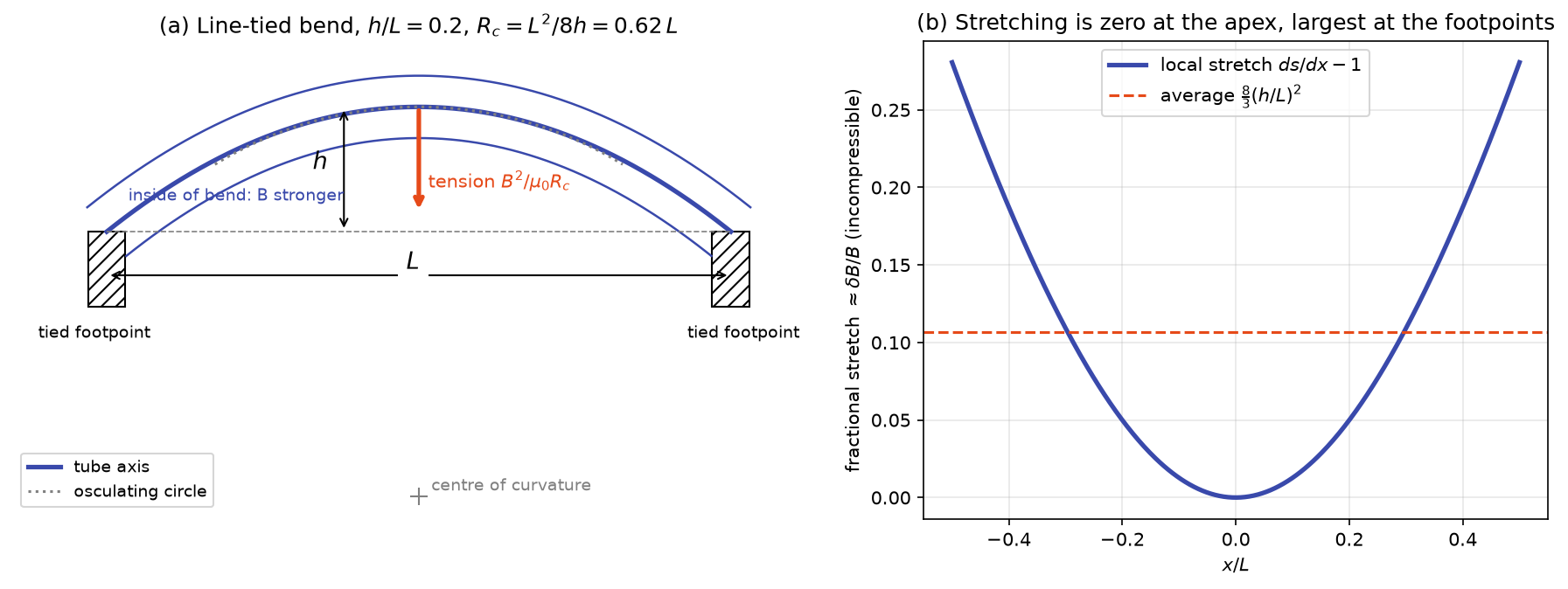
How much does a bend stretch the line?
Hold the footpoints fixed a distance \(L\) apart and bend the line so its middle rises by the sagitta \(h\). A simple shape that does this is the parabola
which is zero at both footpoints \(x=\pm L/2\) and equals \(h\) in the middle. The length of a curve \(y(x)\) is its arc length, the sum of tiny steps \(ds = \sqrt{dx^2 + dy^2}\):
For a gentle bend, \(\sqrt{1+y'^2}\approx 1 + \tfrac12 y'^2\), so the extra length is
Exact result and accuracy
Substituting \(u = 8hx/L^2\) and using \(\int\sqrt{1+u^2}\,du = \tfrac12\big[u\sqrt{1+u^2} + \sinh^{-1}u\big]\),
| \(h/L\) | exact \(\delta\ell/L\) | approximation \(\tfrac83(h/L)^2\) |
|---|---|---|
| 0.1 | 0.026 | 0.027 |
| 0.2 | 0.098 | 0.107 |
| 0.3 | 0.204 | 0.240 |
The approximation is good to a few per cent up to \(h/L\approx0.2\).
Answer
Only a little. The stretching is second order in the bend: a bend of height \(h = 0.2L\) lengthens the line by about 10%, so (if the density stays fixed) \(B\) rises by about 10%. Meanwhile the curvature at the apex, \(1/R_c = 8h/L^2\), is first order in \(h\).
So a gentle bend changes the direction of the field (and creates tension) much more than it changes the strength of the field. This is why bending is the cheapest way to disturb a magnetic field, and why Alfvén waves, which only bend the field, are so easily excited.
Why a parabola? Other shapes
The parabola is a convenient choice, but it also arises physically. Treat the tube as a string with tension \(T = B^2A/\mu_0\) pushed sideways by a uniform force \(f\) per unit length (a steady flow or a pressure difference). For small slopes, \(T\,y'' = -f\), which integrates to exactly this parabola with \(h = fL^2/(8T)\), the same reason a suspension-bridge cable is a parabola.
| Shape | When it arises | \(\delta\ell/L\) for small \(h/L\) |
|---|---|---|
| Parabola | Uniform sideways push | \(\tfrac83(h/L)^2 \approx 2.67(h/L)^2\) |
| Circular arc | Constant curvature | \(\tfrac83(h/L)^2\) to leading order |
| Cosine \(h\cos(\pi x/L)\) | Lowest standing Alfvén wave on a line-tied field line | \(\tfrac{\pi^2}{4}(h/L)^2 \approx 2.47(h/L)^2\) |
The \(h^2\) scaling holds for any smooth shape; only the number in front changes.
5. Line-tying
Question: in sections 4 and 6, the ends of the field line are held fixed. What does that assumption do, and when is it valid?
Line-tying means the footpoints are anchored in a medium that holds them in place, and only the part in between can move. It is scenario (a) of Four ways a field line ends up bent.
- At the footpoints, the field line cannot move sideways.
- Plasma can still flow along the field line, even at the footpoints. Line-tying pins the field's position, not the flow along it.
- Something in the middle must push the line: a flow, a pressure difference, or a wave launched by moving a footpoint. The push is balanced by tension, and that balance sets the shape.
Why it matters.
- It guarantees that a push bends the tube. With the ends fixed, the displacement must vary along the tube, so any push bends it and makes it longer. (Without anchors, a push that is the same along the whole tube would just slide it sideways. A push that varies along the tube still bends it, as in scenario (b).)
- The tube length sets the wavelength. Only bends that fit between the ends are allowed, \(k_\parallel = n\pi/L\). Long tubes bend easily; short ones are stiff.
- It stabilises kinks. A line-tied twisted tube can hold about \(2.5\pi\) of twist before it kinks (Hood & Priest 1981), more than a free one.
| Setting | How good is line-tying? |
|---|---|
| Coronal loops | Nearly perfect: the footpoints sit in the dense, highly conducting photosphere |
| Closed field lines in Earth's magnetosphere | Partial: the ends sit in the ionosphere, which holds them well only if its conductivity is high |
| Laboratory devices | Conducting end plates play the role of the photosphere |
| Near a reconnection site | Does not apply: a freshly reconnected line is not anchored nearby and snaps straight freely |
The magnetospheric case in more detail
How well the ionosphere holds a field line is set by comparing its Pedersen conductance \(\Sigma_P\) (how easily current flows across the field in the ionosphere, integrated over height) with the Alfvén conductance \(\Sigma_A = 1/(\mu_0 v_A)\). When \(\Sigma_P\gg\Sigma_A\), an arriving Alfvén wave reflects as if from a fixed end. When they are comparable, the footpoints slip and the wave's energy is partly absorbed as heat in the ionosphere.
Answer
Fixed footpoints force any push to bend and stretch the line, while plasma can still flow along it. This is an excellent approximation for coronal loops, a partial one in the magnetosphere, and a poor one near a reconnection site.
6. Does the stretching raise B or lower ρ?
Question: with the ends fixed, bending stretches the line, so \(B/\rho\) must grow. Does the field get stronger, or does the plasma get thinner?
It depends on what the plasma can do while the bend happens. Linearising \(B/\rho\propto\ell\):
| Case | When it happens | Result |
|---|---|---|
| 1. Density fixed | Fast bend: no time for plasma to flow along the line | All stretching goes into the field: \(\delta B/B = \delta\ell/\ell\), about 10% for \(h/L=0.2\); the tube thins |
| 2. Plasma drains along the line | Slow bend, low β: plasma has time to flow away and the surrounding field holds \(B\) fixed | \(B\) stays about the same; \(\rho\) drops by \(\delta\ell/\ell\) |
| 3. Plasma is also compressed | The push that bends the tube also squeezes it | \(B\) grows faster than stretching alone (e.g. 5% stretch + 10% compression ≈ 15% rise) |
"Fast" and "slow" are measured against the sound crossing time \(L/c_s\), the time for a pressure signal to travel the length of the tube at the sound speed \(c_s\).
Where along the tube does B grow?
If plasma elements move only sideways, the local stretch is \(ds/dx = \sqrt{1+y'^2}\). It is zero at the apex, where the line is horizontal (\(y'=0\)), and largest at the footpoints, where it reaches about \(8(h/L)^2\). This is panel (b) of the figure above.
So at the most bent point, \(|B|\) on the axis hardly changes. The curvature and tension are concentrated at the apex; the field-strength increase from stretching is concentrated near the fixed ends.
Answer
Fast bends make the field stronger (density fixed); slow bends at low β make the plasma thinner (field fixed); compression makes the field stronger still. In every case the flux \(BA\) through each cross-section is unchanged; only how it is shared between \(B\) and \(A\), and between \(B\) and \(\rho\), changes.
7. When the fluid picture fails
Everything above treats the plasma as a fluid. That works only while particles follow the field lines smoothly, which requires the bend to be much gentler than a particle's gyroradius \(r_L\), the radius of its circular motion around the field (see Particle motion). Büchner and Zelenyi introduced the parameter
For \(\kappa_p\lesssim 3\), the bend is so sharp that particles are thrown off their orbits and scatter chaotically.
What it implies
In Earth's magnetotail, field lines are sharply bent where they cross the thin current sheet. There, ions (and in thin enough sheets, electrons) stop following the field, frozen-in breaks down, and the conditions for reconnection are set up. The fluid picture on this page fails exactly where reconnection begins.
What this means for reconnection
- Outflow jets are tension. A freshly reconnected field line is sharply kinked. Its tension \(B^2/(\mu_0R_c)\) snaps it straight and flings plasma out at about \(v_A\).
- The inflow is not like a line-tied bend. As a spacecraft crosses the current sheet, \(B_L\) drops towards the midplane. That is not caused by stretching: it comes from the field reversing direction, with plasma pressure making up the lost magnetic pressure. See A field line's path into the X-line.
- The inside/outside rule still holds there. Inflowing field lines are bent with their inside facing upstream, so the rule also makes \(B\) weaker towards the sheet; the field reversal just hides it. See Is the field stronger on the inside of the bend here too?
- Energy storage. Twisting, shearing and braiding coronal loops store the energy that reconnection later releases in flares and heating.
Key takeaways
- Plasma flows bend frozen-in field lines; bending stores energy and creates tension \(B^2/(\mu_0R_c)\) towards the centre of the bend.
- The field is stronger on the inside of a bend, by about \(2a/R_c\).
- Bending changes field direction at first order but field strength only at second order (\(\delta\ell/L\approx\tfrac83(h/L)^2\)).
- With fixed ends, \(B/\rho\propto\ell\): stretching raises the field, lowers the density, or both, depending on how fast the bend happens.
- Tension is what makes Alfvén waves travel and what drives reconnection outflows.
Practice problems
Try each problem before opening its solution. Click an option to check a concept question;
type a number and press Check for a numerical one (forms like 6.2e7 or 6.2x10^7 both work).
Concept questions
Problem 1
A very long flux tube with nothing holding its ends is pushed sideways with exactly the same force at every point along its length. What happens?
- It bends, and tension pulls it back.
- It slides sideways as a whole, without bending.
- It stretches, and \(B\) increases.
- It twists around its axis.
Every point moves by the same amount, so the displacement does not vary along the tube: no curvature, no tension, no stretching. Bending needs a displacement that varies along the field (see Four ways a field line ends up bent).
Problem 2
A long, free flux tube is hit by a push that acts only on a short section in the middle. Why does the tube bend, even though nothing anchors it?
- Because the push is very strong.
- Because the plasma pressure inside the tube resists it.
- Because the distant parts of the tube have not moved yet: they only feel the push once a signal reaches them at the Alfvén speed.
- It doesn't bend; it slides.
The far plasma's inertia holds it in place until an Alfvén wave arrives. Over times shorter than \(d/v_A\), plasma a distance \(d\) away acts as a temporary anchor. This is scenario (b).
Problem 3
Which deformation of a flux tube produces a current flowing along the axis of the tube?
- A planar bend (\(m=1\))
- A sausage pinch (\(m=0\))
- Twist
- Fluting (\(m=2\))
Twisting gives the field an azimuthal component \(B_\varphi\) around the axis. By Ampère's law, a field circling the axis requires a current along it, \(J_z\), just like the field around a wire.
Problem 4
A line-tied field line is bent into a parabola, and the plasma is incompressible. Where along the line does the field strength increase the most?
- At the apex, where the bend is sharpest
- Near the footpoints
- Equally everywhere
- Nowhere: bending never changes \(B\)
If plasma moves only sideways, the local stretch is \(\sqrt{1+y'^2}-1\), which depends on the slope. The slope is zero at the apex and largest near the footpoints. Curvature is concentrated at the apex, but field-strength increase is concentrated near the ends.
Problem 5
A ring-shaped flux rope carries a current around the ring. What stops it from expanding?
- An external "strapping" magnetic field
- Line-tying at its footpoints
- The tension of its own field, which always wins
- Nothing: a ring flux rope is always in equilibrium
The hoop force and the stronger magnetic pressure on the inner side push the ring outward, and for a current-carrying rope they beat the inward tension. An external field must hold it; if that field weakens too fast with height, the rope erupts (torus instability).
Show that…
Problem 6: show that B/ρ ∝ ℓ
Using only frozen-in flux and conservation of mass, show that for a thin element of a flux tube \(B/\rho\) is proportional to the element's length \(\ell\).
Hint
Write down what stays constant for the element: the flux through it, and the mass inside it. Both involve the cross-section \(A\).
Proof
Flux is frozen in: \(BA = \Phi\) = const. Mass is conserved: \(\rho A\ell = m\) = const. Dividing the first by the second, \(A\) cancels: \(B/(\rho\ell) = \Phi/m\) = const, so \(B/\rho\propto\ell\).
Problem 7: show that the inside field is stronger
For a current-free field bent into circular arcs about a centre of curvature, show that \(B_{\text{in}}/B_{\text{out}} = (R_c + a)/(R_c - a)\). Explain why the two connecting segments of your loop contribute nothing.
Hint
Use \(\oint\mathbf{B}\cdot d\mathbf{l} = 0\) around the loop ①→②→③→④ in the figure in section 2.
Proof
\(\nabla\times\mathbf{B} = 0\) and Stokes' theorem give \(\oint\mathbf{B}\cdot d\mathbf{l} = 0\). On the connectors ② and ④, \(d\mathbf{l}\) points across the tube while \(\mathbf{B}\) points along it, so \(\mathbf{B}\cdot d\mathbf{l} = 0\). Along the inner arc ① the integral is \(+B_{\text{in}}(R_c-a)\theta\), and back along the outer arc ③ it is \(-B_{\text{out}}(R_c+a)\theta\). Setting the sum to zero gives \(B_{\text{in}}/B_{\text{out}} = (R_c+a)/(R_c-a)\).
Problem 8: the cosine shape
A line-tied field line takes the shape of its lowest standing Alfvén wave, \(y = h\cos(\pi x/L)\) for \(-L/2\le x\le L/2\). Show that for a gentle bend \(\delta\ell/L\approx(\pi^2/4)(h/L)^2\).
Hint
Use \(\delta\ell\approx\tfrac12\int y'^2\,dx\) and the fact that the average of \(\sin^2\) over a half-period is \(\tfrac12\).
Proof
\(y' = -(h\pi/L)\sin(\pi x/L)\), so \(\tfrac12\int_{-L/2}^{L/2} y'^2\,dx = \tfrac12\,\frac{h^2\pi^2}{L^2}\cdot\frac{L}{2} = \frac{\pi^2h^2}{4L}\). Dividing by \(L\): \(\delta\ell/L = (\pi^2/4)(h/L)^2\approx 2.47\,(h/L)^2\).
Problem 9: the radius of curvature of a parabola
Show that the parabola \(y = h(1 - 4x^2/L^2)\) has radius of curvature \(R_c = L^2/(8h)\) at its apex.
Hint
For a curve \(y(x)\), the curvature is \(|y''|/(1+y'^2)^{3/2}\). What is \(y'\) at the apex?
Proof
\(y' = -8hx/L^2\) vanishes at \(x=0\), and \(y'' = -8h/L^2\) everywhere. At the apex the curvature is \(|y''| = 8h/L^2\), so \(R_c = L^2/(8h)\).
Numbers
Problem 10
A coronal loop has footpoints \(L = 50\) Mm apart and is pushed into a parabola of height \(h = 5\) Mm. What is the radius of curvature at its apex?
Solution
\(R_c = L^2/(8h) = 2500/40 = 62.5\) Mm.
Problem 11
For the same loop, by what percentage does the average field strength rise if the density stays fixed?
Solution
\(h/L = 0.1\), so \(\delta B/B = \delta\ell/L\approx\tfrac83(0.1)^2 = 0.0267\), about 2.7%.
Problem 12
The loop's field is \(B = 0.01\) T. What is the tension force per unit volume at the apex, \(B^2/(\mu_0R_c)\)?
Solution
\(B^2/(\mu_0R_c) = (10^{-4})/(1.257\times10^{-6}\times6.25\times10^{7}) = 1.27\times10^{-6}\) N/m³.
Problem 13
A current-free flux tube of radius \(a = 1\) Mm is bent with \(R_c = 10\) Mm. What is \(B_{\text{in}}/B_{\text{out}}\) (exact formula)?
Solution
\((R_c+a)/(R_c-a) = 11/9 = 1.22\). The approximation \(1+2a/R_c = 1.2\) is within 2%.
Problem 14
How long does a bend take to travel the length of the loop (\(L = 50\) Mm) if \(v_A = 1000\) km/s? This is the time over which a free tube's distant plasma acts as an anchor.
Solution
\(L/v_A = 5\times10^{7}\ \text{m}/10^{6}\ \text{m/s} = 50\) s.
Problem 15
A line-tied field line oscillates in its lowest mode with amplitude \(h = 0.2L\). Using the result of Problem 8, by what percentage is it lengthened at maximum displacement?
Solution
\(\delta\ell/L = (\pi^2/4)(0.2)^2 = 0.0987\), about 9.9%: slightly less than the 10.7% of a parabola with the same height.
Further reading
- E. R. Priest, Magnetohydrodynamics of the Sun (Cambridge, 2014): tension, line-tying, coronal loops
- R. M. Kulsrud, Plasma Physics for Astrophysics (Princeton, 2005): frozen-in flux, Walén–Cauchy relation
- D. Biskamp, Magnetic Reconnection in Plasmas (Cambridge, 2000)
- A. W. Hood & E. R. Priest, Geophys. Astrophys. Fluid Dyn. 17, 297 (1981): kink stability of line-tied loops
- J. Büchner & L. M. Zelenyi, J. Geophys. Res. 94, 11821 (1989): chaotic particle motion in curved fields