X-points, O-points and magnetic islands
Advanced level
This page assumes vector calculus (Stokes' theorem, line integrals) and is meant for students who have finished the Plasma Basics and Magnetic Reconnection sections.
Treat \(\psi(L, N)\) as the height of a landscape. Then:
- contour lines of the landscape are field lines,
- steepness is the in-plane field strength \(|\mathbf{B}_{\text{in-plane}}| = |\nabla\psi|\),
- flat spots (\(\nabla\psi = 0\)) are null points, where the in-plane field vanishes.
There are two kinds of null points.
Drag to rotate · scroll to zoom · double-click to reset
X-point: a mountain pass
Near an X-point, \(\psi\) is a saddle, for example \(\psi = (N^2 - L^2)/2\). Walking towards \(\pm N\) takes you uphill into the inflow field lines; walking towards \(\pm L\) takes you downhill into the outflow ones.
The contour at exactly the pass height is the separatrix. On the floor it shows up as the crossing X. It is the boundary between field lines of different connectivity.
X-point with a current sheet
When the sheet is thin, the surface is a steep trough across \(N\) and nearly flat along \(L\). That difference in curvature is the current, \(\mu_0 J_M = \nabla^2\psi\), and it is why the separatrices cross at a shallow angle.
O-point: a summit or pit
Near an O-point, \(\psi\) has a maximum or minimum. Every contour closes around it, so field lines encircle it: this is the core of a magnetic island (or, in 3D, a flux rope). The sign of \(\psi\) only fixes which way the field circulates, so a summit and a pit are both O-points.
Islands: X- and O-points together
The classic island chain combines both:
The \(N^2/2\) term is a field reversal across \(N=0\) (\(B_L = N\)), and the \(\varepsilon\) term breaks the current sheet into islands. Along \(N = 0\):
- X-points at \(L = 0, \pm 2\pi/k, \dots\): \(\cos kL\) is a maximum, so \(\psi\) falls along \(L\) and rises along \(N\). That is a saddle, at height \(\psi_X = \varepsilon\).
- O-points at \(L = \pm\pi/k, \dots\): \(\cos kL\) is a minimum, so \(\psi\) rises in every direction. These are pits, at height \(\psi_O = -\varepsilon\).
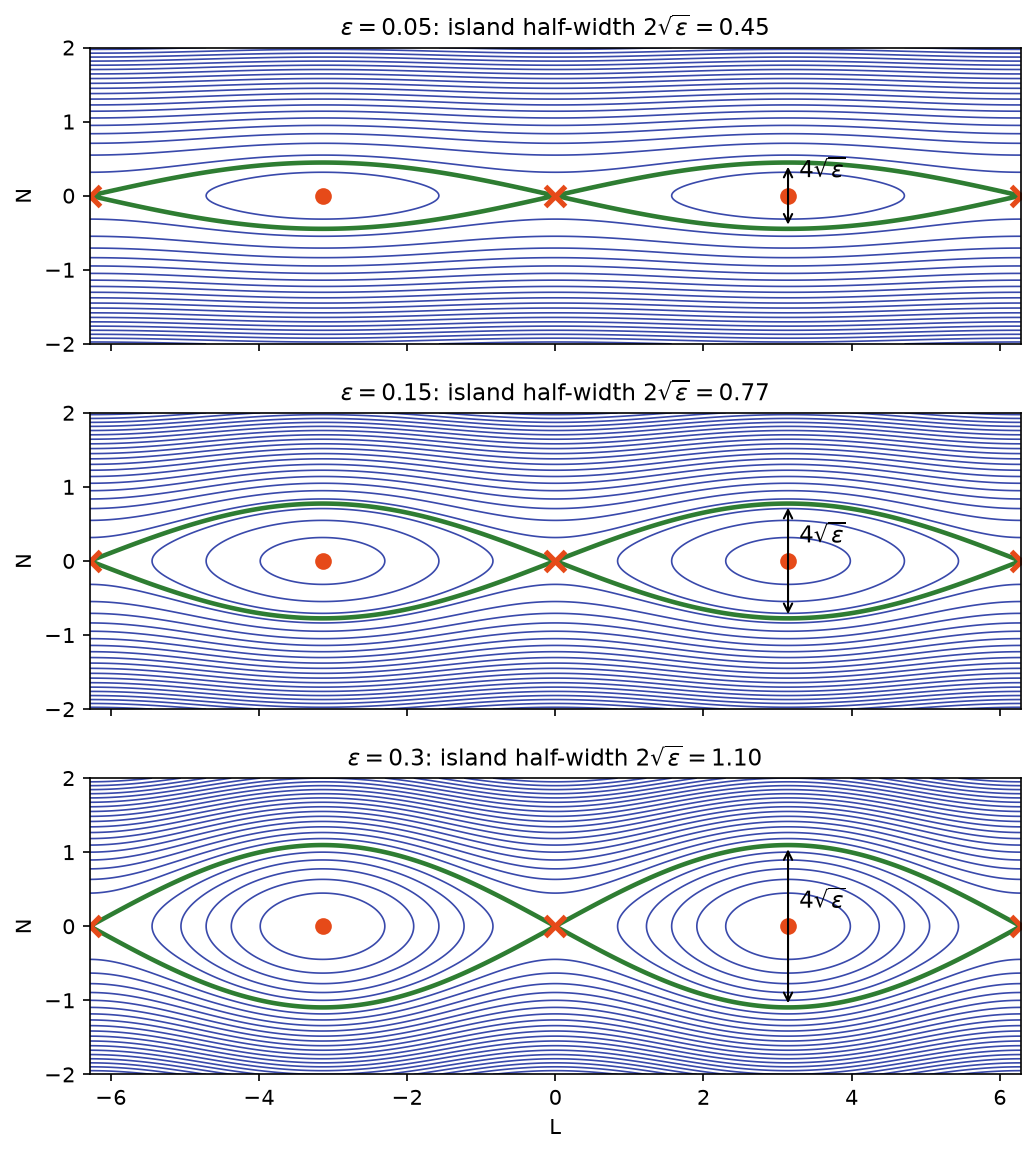
The green separatrix is the contour \(\psi = \psi_X = \varepsilon\). Inside it, field lines close around an O-point (the islands). Outside it, they run open along \(L\). The X-point is the only place where field lines can switch from one family to the other.
How big is an island?
On the separatrix, \(N^2/2 + \varepsilon\cos kL = \varepsilon\), so
At the O-point, \(\cos kL = -1\), giving an island half-width of \(2\sqrt{\varepsilon}\). The flux inside each island is
Island width grows as \(\sqrt{\varepsilon}\), while the flux it contains grows as \(\varepsilon\). Growing the islands means reconnecting more flux, and from the flux function page, that happens at the rate \(d\psi_X/dt = E_M\) at the X-point.
Rotate the landscape below and drag the ε slider to watch the pass (X-point) rise relative to the pits (O-points) and the islands fatten.
Drag to rotate · scroll to zoom · double-click to reset
Check yourself
For the island chain, compute \(\mu_0 J_M\). Where is the current strongest?
Answer
\(\mu_0 J_M = \nabla^2\psi = 1 - \varepsilon k^2\cos kL\). For \(\varepsilon > 0\) it is largest where \(\cos kL = -1\), at the O-points, and smallest at the X-points. The current concentrates inside the islands.
Try it yourself
In scripts/make_figures.py, change the list of eps values in
island_chain_figure() or the wavenumber k, rerun it, and watch the islands change.
Practice problems
Try each problem before opening its solution. Click an option to check a concept question;
type a number and press Check for a numerical one (forms like 6.2e7 or 6.2x10^7 both work).
Concept questions
Problem 1
Viewed as a landscape, what shape does \(\psi\) have near an X-point?
- A saddle (mountain pass)
- A peak
- A pit
- A flat plane
\(\psi\) rises in one direction (towards the inflow) and falls in the other (towards the outflow).
Problem 2
How does the width of a magnetic island scale with the amplitude \(\varepsilon\) of the perturbation?
- As \(\sqrt{\varepsilon}\)
- As \(\varepsilon\)
- As \(\varepsilon^2\)
- It does not depend on it
The half-width is \(2\sqrt{\varepsilon}\), while the flux inside the island grows as \(\varepsilon\). Small perturbations make surprisingly wide islands.
Show that…
Problem 3: the island width
For \(\psi = N^2/2 + \varepsilon\cos kL\), show that the island half-width at the O-point is \(2\sqrt{\varepsilon}\).
Hint
The separatrix is the contour \(\psi = \psi_X = \varepsilon\). Evaluate it at the O-point, where \(\cos kL = -1\).
Proof
On the separatrix, \(N^2/2 = \varepsilon(1-\cos kL)\). At the O-point, \(N^2/2 = 2\varepsilon\), so \(N = 2\sqrt{\varepsilon}\).
Problem 4: current at X and O points
Show that for the island chain \(\mu_0J_M = 1-\varepsilon k^2\cos kL\), and that the current is stronger at the O-points than at the X-points (for \(\varepsilon>0\)).
Hint
\(\mu_0J_M = \nabla^2\psi\).
Proof
\(\nabla^2\psi = \partial_N^2(N^2/2) + \partial_L^2(\varepsilon\cos kL) = 1 - \varepsilon k^2\cos kL\). At the X-points \(\cos kL = 1\) gives \(1-\varepsilon k^2\); at the O-points \(\cos kL = -1\) gives \(1+\varepsilon k^2\), which is larger.
Numbers
Problem 5
What is the island half-width for \(\varepsilon = 0.09\)?
Solution
\(2\sqrt{0.09} = 2\times0.3 = 0.6\).
Problem 6
How much flux (per unit length in \(M\)) is inside each island for \(\varepsilon = 0.09\)?
Solution
\(\psi_X - \psi_O = 2\varepsilon = 0.18\).
Problem 7
With \(k = 1\) and \(\varepsilon = 0.2\), what is \(\mu_0J_M\) at an O-point?
Solution
\(1+\varepsilon k^2 = 1.2\).