What is a plasma?
A plasma is an ionized gas: a collection of free electrons and ions whose behaviour is dominated by collective electromagnetic forces rather than by binary collisions. More than 99% of the visible matter in the universe is plasma.
Not every ionized gas is a plasma. Three conditions must hold.
1. Quasi-neutrality and the Debye length
Question: if you put an extra charge into a plasma, how far away can its electric field be felt?
Where the idea comes from
The concept was invented for salt water, not plasma. In 1923 Peter Debye and Erich Hückel asked why ions in an electrolyte behave as if their charges were partly hidden. Their answer: each ion attracts a cloud of oppositely charged ions around it, and that cloud screens its charge. A few years later Irving Langmuir, studying electrical discharges in gases, found the same effect with electrons, and in 1928 named the ionised gas a "plasma". The screening distance kept Debye's name.
The physical picture: introducing a test charge
Imagine an initially neutral, uniform plasma with equal electron and ion densities \(n_e = n_i = n_0\). Now insert a positive test charge \(+q\) at the origin:
- The electric field reaches out: The bare test charge creates a radially outward Coulomb electric field \(\mathbf{E} = \frac{q}{4\pi\varepsilon_0 r^2}\hat{\mathbf{r}}\), pointing away from the origin.
- Electrons respond instantly: Electrons are light and nimble (\(m_e \ll m_i\)). They feel an inward electrostatic force \(-e\mathbf{E}\) and surge toward \(+q\), crowding around the origin.
- Ions form a stationary background: Ions are thousands of times heavier (\(m_p/m_e \approx 1836\)). On the rapid timescale of electron motion (\(\sim 1/\omega_{pe} \sim 10^{-11}\) s), ions cannot accelerate fast enough to move, so their density remains uniform: \(n_i \approx n_0\).
- Thermal motion resists crowding: If electrons were cold (\(T_e = 0\)), they would collapse directly onto the test charge. Because they have thermal kinetic energy (\(T_e > 0\)), their outward thermal pressure resists being confined into a point.
- A steady screening cloud forms: An equilibrium is reached where the inward electrostatic attraction balances the outward thermal pressure push. This creates a localized, diffuse cloud of excess electrons—the Debye shielding cloud—that neutralizes the test charge for observers outside it.
Where does the Boltzmann distribution come from?
Why does the electron density follow \(n_e(r) = n_0\,e^{e\phi(r)/k_B T_e}\)? This fundamental relation can be understood from two complementary perspectives:
In steady state, the electron fluid as a whole is at rest (\(\mathbf{v}_e = 0\)). The sum of forces acting on the electron fluid per unit volume must vanish:
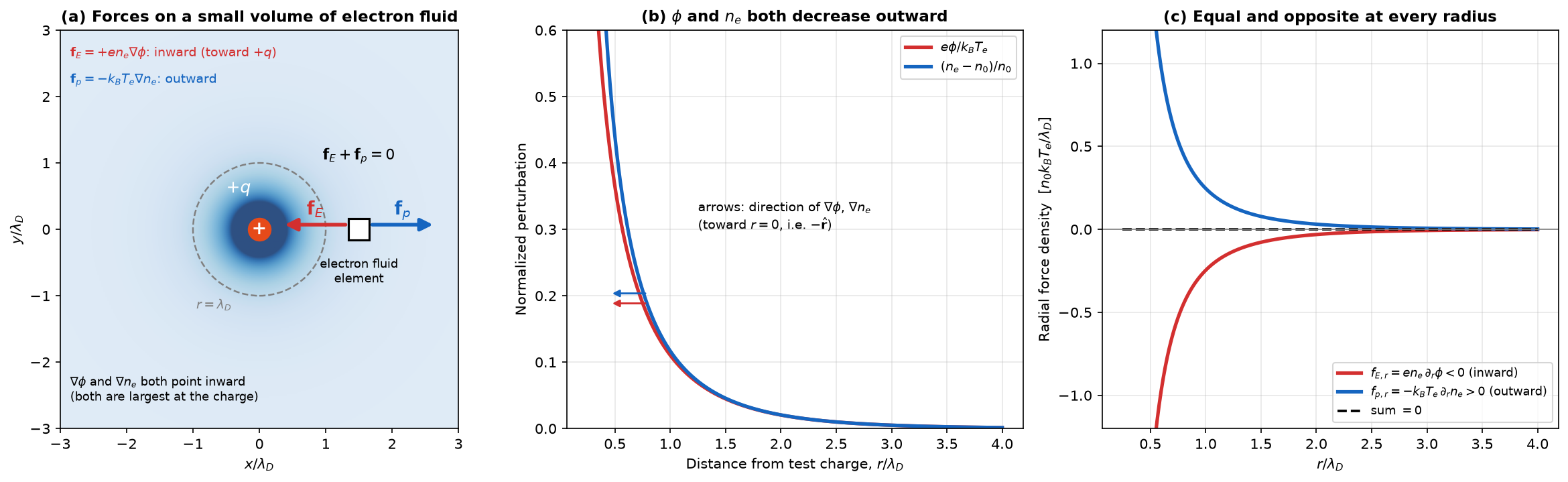
- Electrostatic force density: \(\mathbf{f}_E = -e\,n_e\mathbf{E} = +e\,n_e\,\nabla\phi\), pulling electrons toward regions of high positive potential.
- Thermal pressure gradient force density: \(\mathbf{f}_p = -\nabla p_e\). Assuming an ideal gas \(p_e = n_e k_B T_e\), and noting that electrons conduct heat so rapidly that they remain isothermal (\(\nabla T_e \approx 0\)), this is \(\mathbf{f}_p = -k_B T_e\,\nabla n_e\).
Which way do they point? For a positive test charge, \(\phi\) is largest at the charge and falls off outward, so \(\nabla\phi\) points inward, toward \(+q\). Electrons crowd toward the charge, so \(n_e\) also falls off outward and \(\nabla n_e\) points inward too. Because \(\mathbf{f}_E = +e\,n_e\nabla\phi\), the electrostatic force points inward. The minus sign in \(\mathbf{f}_p = -k_BT_e\nabla n_e\) turns the pressure force outward: the fluid is pushed from high density to low density. In radial components,
In steady state the two have equal magnitude at every radius, so they cancel on each small volume of electron fluid:
Equating the two opposing forces:
Because \(\frac{\nabla n_e}{n_e} = \nabla(\ln n_e)\), we integrate both sides from infinity (where the undisturbed plasma has \(\phi = 0\) and \(n_e = n_0\)) to radius \(r\):
The Boltzmann factor is simply the mechanical balance between electrostatic attraction and thermal kinetic pressure!
In thermodynamic equilibrium at temperature \(T_e\), particles in a heat bath occupy phase-space states with probability proportional to the canonical Gibbs factor \(e^{-\mathcal{E}/k_B T_e}\), where \(\mathcal{E}\) is the single-particle energy:
Here the potential energy of an electron (charge \(-e\)) in the electrostatic potential \(\phi(\mathbf{x})\) is \(U(\mathbf{x}) = q_e\,\phi(\mathbf{x}) = -e\phi(\mathbf{x})\). The phase-space distribution is:
Integrating over all electron velocities \(\mathbf{v}\) yields the spatial number density:
Deriving the Debye length and the screened potential
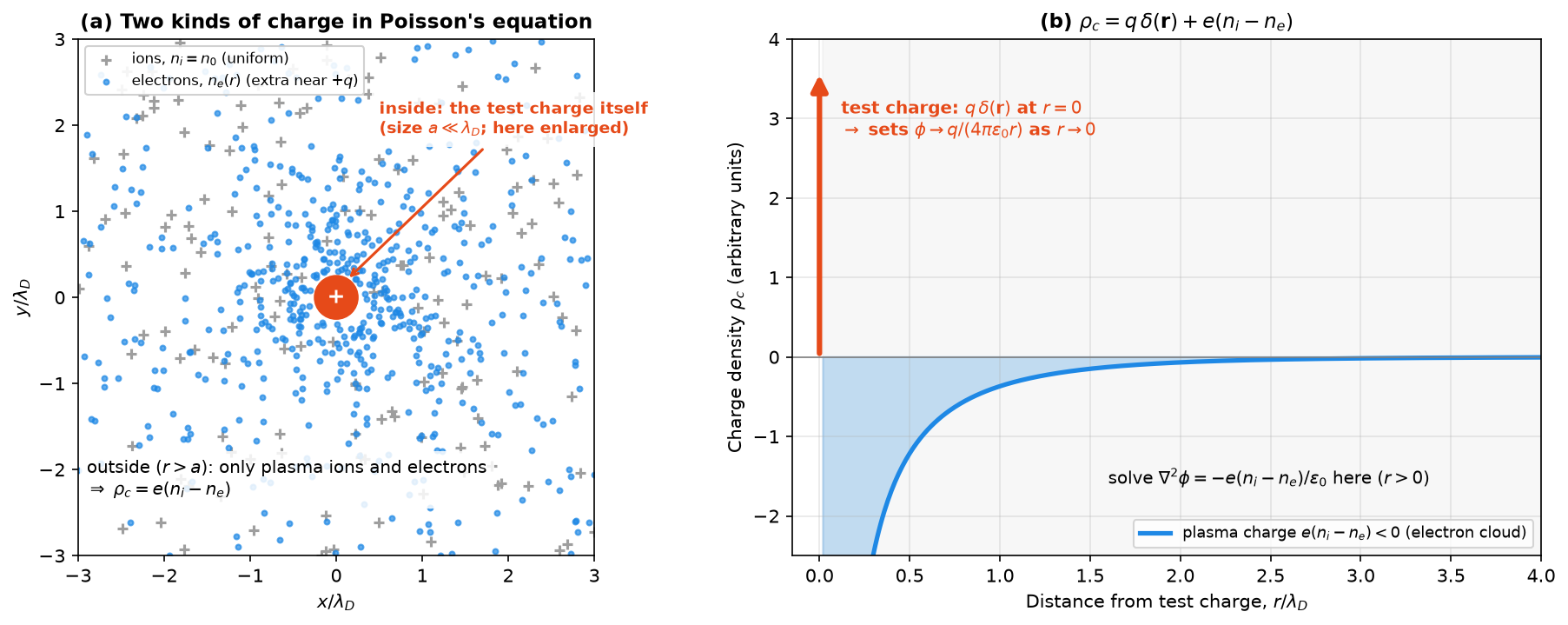
The electrostatic potential obeys Poisson's equation \(\nabla^2\phi = -\rho_c/\varepsilon_0\). The charge density \(\rho_c\) has two parts:
- The test charge itself. It occupies a tiny region at the origin, much smaller than \(\lambda_D\), so we treat it as a point charge, \(q\,\delta(\mathbf{r})\).
- The plasma's own charges. Ions and electrons fill all the space around it, giving \(e(n_i - n_e)\).
"Outside the test charge" means every point except the origin (\(r > 0\)). There only plasma particles are present, so \(\rho_c = e(n_i - n_e)\). We solve Poisson's equation in this region. The test charge enters only through the condition at \(r \to 0\), where \(\phi\) must approach its bare Coulomb potential \(q/(4\pi\varepsilon_0 r)\); this is used below to fix the constant \(C_1\).
Where the potential is weak compared to electron thermal energy (\(e\phi \ll k_B T_e\)), we linearize the exponential:
Substituting \(n_i = n_0\) and \(n_e\) into Poisson's equation:
where we define the Debye length:
In spherical coordinates with radial symmetry, \(\nabla^2\phi = \frac{1}{r}\frac{d^2}{dr^2}(r\phi) = \frac{\phi}{\lambda_D^2}\). Setting \(u(r) = r\phi(r)\) transforms this into the ordinary differential equation:
For the potential to remain finite as \(r \to \infty\), we must have \(C_2 = 0\). As \(r \to 0\), the shielding cloud has negligible enclosed volume, so \(\phi(r)\) must approach the bare Coulomb potential of the test charge, \(\frac{q}{4\pi\varepsilon_0 r}\). This sets \(C_1 = \frac{q}{4\pi\varepsilon_0}\):
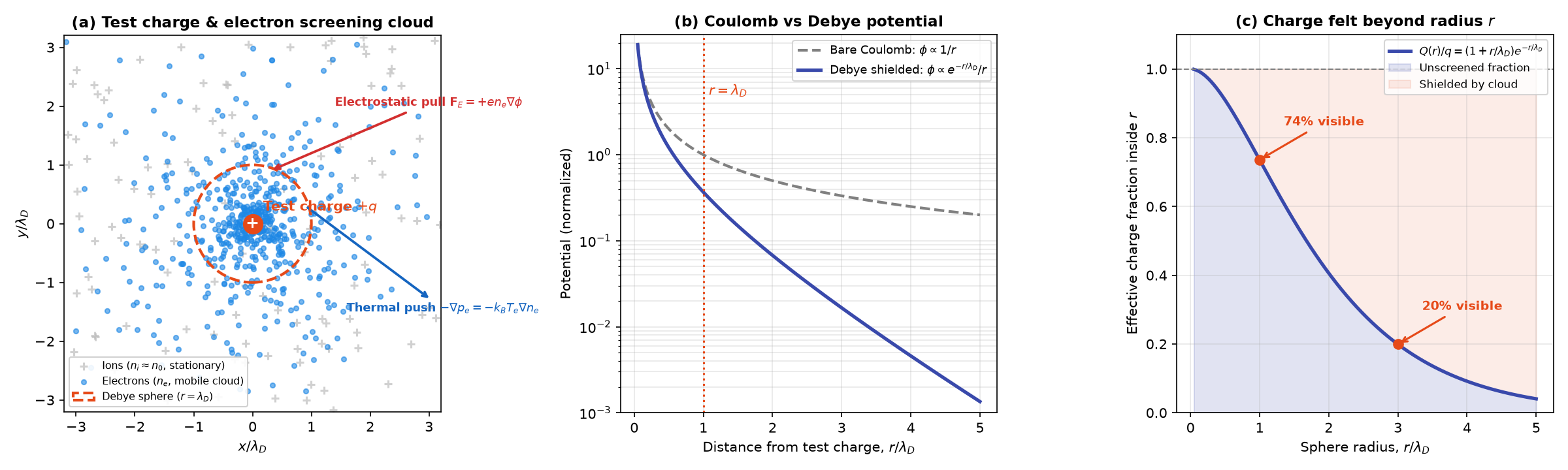
This is the Debye–Hückel (or Yukawa) potential: the bare \(1/r\) Coulomb potential cut off exponentially by the factor \(e^{-r/\lambda_D}\).
Does the cloud completely cancel the charge?
Yes, exactly. The excess charge density in the electron cloud is \(\rho_{\text{cloud}}(r) = -e(n_e - n_0) = -\varepsilon_0 \phi(r) / \lambda_D^2\). Integrating this charge density over all space:
Integrating by parts, \(\int_0^\infty r\,e^{-r/\lambda_D}dr = \lambda_D^2\), so:
The total net charge of the test charge plus its shielding cloud is \(q + Q_{\text{cloud}} = q - q = 0\). Outside the cloud (\(r \gg \lambda_D\)), the plasma sees zero net charge and zero electric field.
Using Gauss's law, the effective unscreened charge felt inside a sphere of radius \(r\) is:
As seen in panel (c) above: - Within one Debye length (\(r = \lambda_D\)), \(Q/q = 2/e \approx 74\%\) of the charge is still felt. - By three Debye lengths (\(r = 3\lambda_D\)), \(Q/q = 4/e^3 \approx 20\%\) is felt. - Beyond \(5\lambda_D\), \(Q/q \approx 4\%\): the test charge has been completely shielded by the electron cloud.
Answer
A charge's field is felt out to about one Debye length; a few \(\lambda_D\) away it is screened almost completely. So a plasma can have local charge imbalances only on scales smaller than \(\lambda_D\). On larger scales it is quasi-neutral, \(n_e\approx n_i\), and for an ionised gas to count as a plasma, it must be much larger than its Debye length:
2. Many particles in a Debye sphere
Question: why talk about a Debye sphere, and why must it contain many particles?
Shielding works the same in every direction, so the region around a charge in which its field still acts is a sphere of radius \(\lambda_D\): the Debye sphere. The screening cloud lives inside it. But the cloud is not a smooth fluid; it is made of individual electrons. The number of particles in a Debye sphere is the plasma parameter
Where the formula comes from
\(N_D\) is a count: number density times the volume of a sphere of radius \(\lambda_D\). Substituting \(\lambda_D = \sqrt{\varepsilon_0 k_BT_e/(n_e e^2)}\) shows what it depends on:
How many electrons does the cloud need?
The amount is not assumed; it follows from the screened potential. Above we found that the cloud carries exactly \(Q_{\text{cloud}} = -q\). For a test charge \(q = +e\), that is one extra electron in total, whatever the density or temperature. How much of it lies within radius \(r\) follows from Gauss's law, \(Q_{\text{cloud}}(<r) = Q(r) - q\):
So inside the Debye sphere the cloud is about \(0.26\) of one electron, while \(N_D\) electrons are already there. The fractional change in density needed for shielding is therefore
The required amount is fixed by \(q\); what \(N_D\) decides is whether that amount is a small adjustment to many electrons (the picture we assumed) or a large rearrangement of a few.
Why the derivation needs many particles per Debye sphere
The derivation of \(\lambda_D\) made two assumptions. Both turn out to be conditions on \(N_D\).
1. Linearization, \(e\phi \ll k_BT_e\). For a test charge \(+e\), \(e\phi/k_BT_e\) reaches 1 at the distance where the Coulomb energy equals the thermal energy, the Landau length \(r_L = e^2/(4\pi\varepsilon_0 k_BT_e)\). Using \(\varepsilon_0 k_BT_e = n_e e^2\lambda_D^2\) from the definition of \(\lambda_D\):
The linearization fails only inside this core. It is a negligible part of the cloud when \(N_D \gg 1\).
2. A smooth density \(n_e(r)\). Poisson's equation used a continuous density that varies on the scale \(\lambda_D\). That needs many particles within that scale. The typical spacing between particles is the radius \(a\) of a sphere that holds one particle on average, \(\tfrac{4\pi}{3}a^3 n_e = 1\):
The density is smooth on the scale \(\lambda_D\) only if \(a \ll \lambda_D\), i.e. \(N_D \gg 1\).
Combining the two: at the distance of a nearest neighbour, the potential energy compared to the thermal energy is
which is the coupling parameter \(\Gamma \sim N_D^{-2/3}\) used below.
| \(N_D\) | \(r_L/\lambda_D = 1/(3N_D)\) | \(a/\lambda_D = N_D^{-1/3}\) | \(\delta N/N_D \approx 0.26/N_D\) |
|---|---|---|---|
| 3 | 0.11 | 0.69 | 9% |
| 30 | 0.011 | 0.32 | 0.9% |
| 300 | 0.0011 | 0.15 | 0.09% |
| \(2\times10^{10}\) (solar wind) | \(2\times10^{-11}\) | \(4\times10^{-4}\) | \(10^{-11}\) |
Move the slider below to see this. In the 3D view, with \(N_D\approx3\) the "cloud" around the test charge is a handful of electrons, and the smooth, averaged picture used to derive \(\lambda_D\) makes no sense; with \(N_D\approx300\) it is a well-defined, smooth concentration of electrons. The bottom panel plots \(e\phi/k_BT_e\) for a test charge \(+e\). The shaded core, where \(e\phi > k_BT_e\) and the linearization fails, shrinks as \(1/N_D\), and the dashed line, the spacing between particles, moves inside the Debye sphere as \(N_D^{-1/3}\).
Drag to rotate · scroll to zoom · double-click to reset
The ions are drawn uniform (they are too heavy to respond quickly). In the 3D view the electron excess near the test charge is exaggerated so that it is visible; the bottom panel is to scale.
Answer
The Debye sphere is the region in which a charge's field is felt. Debye shielding is a statistical effect: it describes the average response of many electrons. It only works if many particles take part, so a plasma needs
Equivalently, the ratio of electrostatic potential energy between nearest neighbours to thermal kinetic energy (the plasma coupling parameter \(\Gamma \sim E_{\text{pot}} / E_{\text{kin}} \sim N_D^{-2/3}\)) must be much less than 1. When that fails (\(\Gamma \gtrsim 1\)), as in the interiors of white dwarfs or in ultracold neutral plasmas, particles are locked to their neighbours by strong Coulomb interactions and the plasma is called strongly coupled.
Why don't particles "run out" if every particle is shielded?
A common question is: if every ion is surrounded by a shielding cloud of electrons, don't the electrons get "used up"? If electrons clump around ion A, how can they simultaneously shield neighboring ion B without running out?
The resolution lies in three fundamental properties of a plasma with \(N_D \gg 1\):
-
The density perturbation is microscopic (\(\sim 1/N_D\)): To shield a single ion of charge \(+e\), the shielding cloud requires an excess of exactly one net electron spread throughout the entire Debye sphere. Because a Debye sphere contains \(N_D \gg 1\) electrons (for example, \(N_D \sim 10^6\) in a tokamak or \(10^{10}\) in the solar wind), the fractional increase in electron density needed to shield any one ion is minuscule:
\[ \frac{\delta n_e}{n_0} \sim \frac{1}{N_D} \sim 10^{-6} \ll 1 . \]No ion "claims" an electron as its private property. The electron density remains essentially uniform everywhere.
-
Linear superposition of overlapping clouds: Because each individual perturbation is tiny (\(e\phi / k_B T_e \sim 1/N_D \ll 1\)), the governing Poisson equation is strictly linear. Linear systems obey the principle of superposition: the total electrostatic potential in the plasma is simply the sum of the individual Yukawa potentials:
\[ \phi(\mathbf{r}) = \sum_j \frac{q_j}{4\pi\varepsilon_0 |\mathbf{r} - \mathbf{r}_j|}\,\exp\!\left(-\frac{|\mathbf{r} - \mathbf{r}_j|}{\lambda_D}\right). \]Every single particle creates its own screened cloud independently. Millions of Debye spheres overlap in the exact same volume of space without competing or depleting the available electrons, just like sound waves from many instruments passing through the same air.
-
Shielding is dynamic and statistical (pair correlation): Electrons are not static; they fly through the plasma at thermal speed (\(v_{th,e} \sim 10^6\) m/s). An electron traverses a Debye sphere in a transit time \(\tau \sim \lambda_D / v_{th,e} \sim 1/\omega_{pe} \sim 10^{-11}\) s. As an electron speeds past ion A, its trajectory bends slightly toward ion A, causing it to spend an extra femtosecond near ion A. A moment later, it speeds past ion B and spends an extra femtosecond near ion B. Averaged over time (or across the thermal distribution), this tiny statistical delay creates an average excess of \(+1\) electron around ion A, and simultaneously \(+1\) around ion B. In statistical mechanics, this is described by the pair correlation function:
\[ g_{ie}(r) = 1 + \frac{e^2}{4\pi\varepsilon_0 k_B T_e r}\,e^{-r/\lambda_D}. \]
When would particles run out?
If \(N_D \sim 1\), an ion would need to capture a significant fraction of an electron, so particles would run out. Neighboring charges would violently compete, linearity breaks down, and electrons become bound into neutral atoms or locked into a crystal lattice. That is a neutral gas or a strongly coupled liquid/solid, not a plasma!
3. Collective behaviour beats collisions
Displace the electrons relative to the ions and they oscillate at the electron plasma frequency
Derivation from a displaced slab of electrons
Imagine displacing a uniform slab of electrons by a distance \(x\) relative to stationary ions. This uncovers an unneutralized surface charge \(\sigma = \pm n_e e x\) on the slab boundaries, creating an internal restoring electric field \(E = \sigma / \varepsilon_0 = n_e e x / \varepsilon_0\).
The electrostatic force on each electron is \(F = -e E = -\frac{n_e e^2}{\varepsilon_0}\,x\).
By Newton's second law, \(m_e \ddot{x} = -\frac{n_e e^2}{\varepsilon_0}\,x\), or:
This is a harmonic oscillator: electrons overshoot under their own inertia and oscillate collectively about the background ions.
For collective behaviour to dominate, these oscillations must happen faster than collisions with neutrals: \(\omega_{pe}\,\tau_{\text{coll}} > 1\).
Typical plasmas
| Plasma | \(n\) (m\(^{-3}\)) | \(T\) (K) | \(B\) (T) |
|---|---|---|---|
| Solar corona | \(10^{15}\) | \(10^{6}\) | \(10^{-2}\) |
| Solar wind (1 AU) | \(5\times10^{6}\) | \(10^{5}\) | \(5\times10^{-9}\) |
| Earth's magnetotail | \(10^{5}\)–\(10^{6}\) | \(10^{7}\) | \(2\times10^{-8}\) |
| Tokamak core | \(10^{20}\) | \(10^{8}\) | \(5\) |
Check yourself
Compute \(\lambda_D\) for the solar wind using the table above. How does it compare to the size of the Earth (\(6.4\times10^6\) m)?
Answer
\(\lambda_D = \sqrt{\varepsilon_0 k_B T_e / n_e e^2} \approx 10\) m. That is tiny compared to any system size of interest, so the solar wind is an excellent plasma.
Practice problems
Try each problem before opening its solution. Click an option to check a concept question;
type a number and press Check for a numerical one (forms like 6.2e7 or 6.2x10^7 both work).
Concept questions
Problem 1
Which of these is not one of the conditions for an ionised gas to behave as a plasma?
- \(L\gg\lambda_D\)
- \(N_D\gg1\)
- \(\omega_{pe}\tau_{\text{coll}}>1\)
- \(T > 10^6\) K
Plasmas exist at all temperatures: the ionosphere is about \(10^3\) K. What matters is shielding (\(L\gg\lambda_D\)), many particles per Debye sphere, and collective motion beating collisions.
Problem 2
At fixed temperature, the electron density increases by a factor of 4. What happens to the Debye length?
- It doubles
- It halves
- It increases by a factor of 4
- It does not change
\(\lambda_D\propto n_e^{-1/2}\), so four times the density gives half the Debye length: more electrons shield a charge more quickly.
Problem 3
Why must there be many particles inside a Debye sphere (\(N_D\gg1\))?
- Shielding is a collective, statistical effect, which needs many particles to work
- So that the plasma is hot enough to stay ionised
- So that the plasma is neutral even on the smallest scales
- To make collisions frequent
Debye shielding comes from the average rearrangement of many electrons. With only a few particles in a Debye sphere, the idea of a smooth screening cloud breaks down.
Show that…
Problem 4: how ND scales
Show that the plasma parameter scales as \(N_D\propto T_e^{3/2}\,n_e^{-1/2}\).
Hint
Substitute \(\lambda_D\propto (T_e/n_e)^{1/2}\) into \(N_D = \tfrac{4\pi}{3}n_e\lambda_D^3\).
Proof
\(N_D\propto n_e\lambda_D^3\propto n_e\,(T_e/n_e)^{3/2} = T_e^{3/2}n_e^{-1/2}\). Hot, tenuous plasmas such as the solar wind therefore have enormous \(N_D\).
Problem 5: Debye length × plasma frequency
Show that \(\lambda_D\,\omega_{pe} = \sqrt{k_BT_e/m_e}\), the electron thermal speed. What does this mean physically?
Hint
Multiply the two formulas; \(n_e\), \(e\) and \(\varepsilon_0\) cancel.
Proof
\(\lambda_D\omega_{pe} = \sqrt{\dfrac{\varepsilon_0k_BT_e}{n_ee^2}\cdot\dfrac{n_ee^2}{\varepsilon_0m_e}} = \sqrt{\dfrac{k_BT_e}{m_e}}\). In one plasma oscillation an electron moving at the thermal speed travels about one Debye length: shielding is set up on the timescale \(1/\omega_{pe}\).
Numbers
Problem 6
What is the Debye length in the solar wind (\(n_e = 5\times10^6\) m\(^{-3}\), \(T_e = 10^5\) K)?
Solution
\(\lambda_D = \sqrt{\varepsilon_0k_BT_e/(n_ee^2)} = 9.8\) m.
Problem 7
What is the electron plasma frequency \(f_{pe} = \omega_{pe}/2\pi\) in the solar corona (\(n_e = 10^{15}\) m\(^{-3}\))? Give it in MHz.
Solution
\(f_{pe}\approx 8.98\sqrt{n_e}\) Hz \(= 8.98\times3.16\times10^7\) Hz \(\approx 284\) MHz.
Problem 8
Estimate the plasma parameter \(N_D\) for the solar wind (use your Debye length from above). An order of magnitude is enough.
Solution
\(N_D = \tfrac{4\pi}{3}(5\times10^6)(9.76)^3\approx 2\times10^{10}\): an extremely good plasma.
Problem 9
What is the Debye length in a tokamak core (\(n_e = 10^{20}\) m\(^{-3}\), \(T_e = 10^8\) K)? Give it in micrometres.
Solution
\(\lambda_D = \sqrt{\varepsilon_0k_BT_e/(n_ee^2)}\approx 6.9\times10^{-5}\) m \(= 69\) μm.
Problem 10
Using \(Q(r) = q\,(1 + r/\lambda_D)\,e^{-r/\lambda_D}\), what fraction of a test charge is still unscreened at a distance of \(3\lambda_D\)? Give it as a percentage.
Solution
\(Q/q = (1+3)\,e^{-3} = 4\times0.0498 = 0.199\), about 20%. At \(5\lambda_D\) it is only 4%.