The Sweet–Parker model
The first quantitative model of reconnection (Sweet 1958; Parker 1957) treats the diffusion region as a long, thin, steady current sheet in resistive MHD.
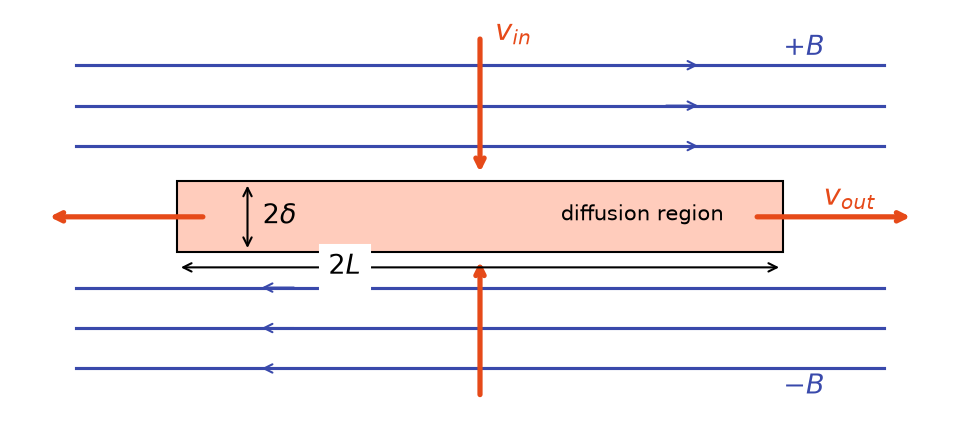
The sheet has length \(2L\) and thickness \(2\delta\), with \(\delta \ll L\). Plasma flows in at speed \(v_{in}\) and out at speed \(v_{out}\).
Derivation in three steps
1. Mass conservation. For incompressible flow, what comes in must go out:
2. Outflow speed. Plasma in the sheet is accelerated to the outflow exhausts. There are two complementary ways to see this:
- Pressure perspective: Total pressure is balanced across the inflow. At the central neutral line where \(B \to 0\), plasma pressure peaks at \(p_0 \approx p_{in} + B^2/(2\mu_0)\). Along the sheet towards the exhaust (where \(p \to p_{in}\)), this strong plasma pressure gradient accelerates the fluid: \(\frac{1}{2}\rho v_{out}^2 \approx p_0 - p_{in} \approx B^2/(2\mu_0)\).
- Tension perspective: Reconnected field lines possess sharp curvature at the ends of the diffusion region; their magnetic tension \((\mathbf{B}\cdot\nabla)\mathbf{B}/\mu_0\) acts like a slingshot pulling the plasma outward.
Both viewpoints yield the same outflow speed:
3. Steady state in the sheet. Field is carried in by advection at the same rate it diffuses away inside the sheet:
The result
Eliminate \(\delta\) using steps 1 and 3: \(v_{in}^2 = \eta v_A / L\). Dividing by \(v_A^2\) gives the reconnection rate (the inflow Alfvén Mach number):
where \(S = L v_A/\eta\) is the Lundquist number. The time to reconnect the flux is
Note this lies between the Alfvén time \(\tau_A\) and the diffusion time \(\tau_D = S\,\tau_A\). Sweet–Parker is much faster than pure diffusion, but is it fast enough?
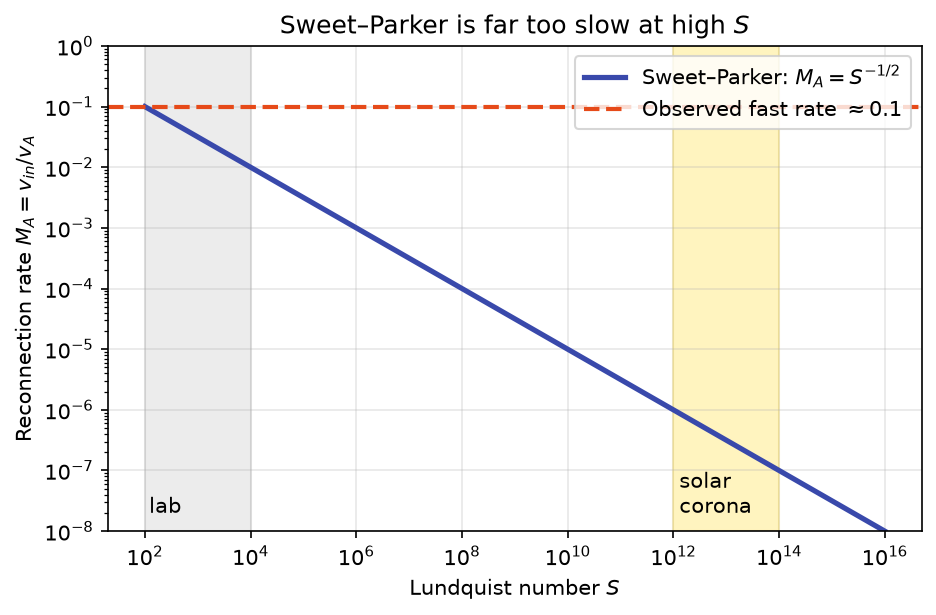
The problem: it is far too slow
A solar flare
With \(L \sim 10^7\) m and \(v_A \sim 10^6\) m/s, the Alfvén time is \(\tau_A \sim 10\) s. For \(S \sim 10^{13}\):
Real flares release their energy in minutes to hours, and the observed reconnection rate is \(M_A \sim 0.1\), independent of \(S\).
This mismatch is the fast reconnection problem. Solving it leads to the Petschek model, Hall (collisionless) reconnection, and the plasmoid instability, which are the topics of the next sections.
Check yourself
In a laboratory experiment, \(S \sim 10^3\). What Sweet–Parker rate and sheet aspect ratio \(\delta/L\) do you expect?
Answer
\(M_A = \delta/L = S^{-1/2} \approx 0.03\). At low \(S\), Sweet–Parker is a reasonable description, and lab experiments such as MRX confirmed the scaling.
Practice problems
Try each problem before opening its solution. Click an option to check a concept question;
type a number and press Check for a numerical one (forms like 6.2e7 or 6.2x10^7 both work).
Concept questions
Problem 1
If the resistivity \(\eta\) increases by a factor of 4, how does the Sweet–Parker reconnection rate change?
- It doubles
- It increases four times
- It halves
- It does not change
\(M_A = S^{-1/2}\propto\eta^{1/2}\): four times the resistivity doubles the rate.
Problem 2
Why is the outflow speed about the Alfvén speed?
- Magnetic pressure upstream is converted into flow energy
- The inflow speed is the Alfvén speed
- Resistivity accelerates the plasma
- Gravity pulls the plasma out
Balancing \(B^2/2\mu_0\) against \(\rho v_{out}^2/2\) gives \(v_{out}\approx v_A\) (or equivalently, bent reconnected field lines release magnetic tension like slingshots to accelerate the outflow to the Alfvén speed).
Problem 3
What does a Sweet–Parker current sheet look like at very large \(S\)?
- Extremely long and thin
- Short and thick
- Circular
- It has no particular shape
\(\delta/L = S^{-1/2}\): for \(S = 10^{12}\) the sheet is a million times longer than it is thick.
Show that…
Problem 4: the Sweet–Parker rate
From \(v_{in}L = v_{out}\delta\), \(v_{out} = v_A\) and \(v_{in} = \eta/\delta\), show that \(M_A = v_{in}/v_A = S^{-1/2}\).
Hint
Eliminate \(\delta\) between the first and third relations.
Proof
From the first, \(\delta = v_{in}L/v_A\). Substituting into the third, \(v_{in} = \eta v_A/(v_{in}L)\), so \(v_{in}^2 = \eta v_A/L\) and \(v_{in}/v_A = \sqrt{\eta/(Lv_A)} = S^{-1/2}\).
Problem 5: a geometric mean
Show that the Sweet–Parker time is the geometric mean of the Alfvén and diffusion times: \(\tau_{SP} = \sqrt{\tau_A\tau_D}\).
Hint
Use \(\tau_{SP} = \tau_AS^{1/2}\) and \(\tau_D = S\tau_A\).
Proof
\(\sqrt{\tau_A\tau_D} = \sqrt{\tau_A\cdot S\tau_A} = \tau_AS^{1/2} = \tau_{SP}\).
Numbers
Problem 6
A sheet has \(S = 10^8\), \(L = 10^7\) m and \(v_A = 10^6\) m/s. What is the Sweet–Parker inflow speed, in m/s?
Solution
\(v_{in} = v_AS^{-1/2} = 10^6\times10^{-4} = 100\) m/s.
Problem 7
For the same sheet, how long does Sweet–Parker reconnection take, in hours?
Solution
\(\tau_{SP} = \tau_AS^{1/2} = 10\ \text{s}\times10^4 = 10^5\) s \(\approx 27.8\) hours.
Problem 8
How thick is a Sweet–Parker sheet with \(L = 10^7\) m and \(S = 10^{12}\), in metres?
Solution
\(\delta = LS^{-1/2} = 10^7\times10^{-6} = 10\) m: far thinner than any observed coronal structure.